
Blogs

Election Translation? It's Easy If You Plan for It!
As an elections professional, you have a wide variety of regulations you need to keep in mind as you look towards translating your documents for the next election. Regardless of your goals surrounding language access and voter turnout, understanding what documents are vital for election translation can help to ensure those goals are met. While each county has different threshold languages and may require different language services in addition to translation, having these documents standardized can promote the success of your language goals. Election translation is individualized by county, and dependent on what your threshold languages are. The Voting Rights Act states that, for all of your threshold languages, you need to translate the following documents: The direct language from the Voting Rights Act says, “The requirements of the law are straightforward: all election information that is available in English must also be available in the minority language so that all citizens will have an effective opportunity to register, learn the details of the elections, and cast a free and effective ballot.” With this in mind, determining your threshold languages is your highly important next step. The Secretary of State’s office will provide you with a list, but if you’re interested in how these are decided, these are the qualifying factors that make a language a threshold language: While translating for your threshold languages is legally mandated, many counties choose to expand the number of languages they translate their documents into even further. If there’s a growing language community in your area, it may be worth translating your documents into that language to promote access and increase voter turnout. Additionally, talking to the language communities in your district can help you to understand the efficacy of your translations, and whether they’re providing access in the way you would like them to. If you’re starting a new election translation project, or want to ensure that you’re prepared before the next election, we can help. From determining your threshold languages to which documents you need to translate, we’ve managed a wide variety of election translation projects for over 20 years. Call us at 530-750-2040 or request a free quote today, and start a partnership with a Language Service Provider you can trust.

What Do You Know About Your Healthcare Translators?
As you look towards hiring a Language Service Provider (LSP), one key question you need to ask is who will complete your translations, and what their qualifications are. This is of particular importance in healthcare organizations because you need to be sure that your healthcare translators are HIPAA certified and understand how to handle Protected Health Information (PHI). While each LSP will have a different process for testing and qualifying their translators, our process will give you insight into what the qualification of healthcare translators looks like. At Avantpage, we hold high standards for all of our translators, healthcare translators included. The minimum qualification standards of our healthcare translators are as follows: Beyond these minimum qualifications, we maintain a list of core verifiable credentials which informs our translator recruitment process. Those credentials for healthcare translators include: While all of these qualifications and verifiable credentials provide us with excellent candidates for healthcare translators, we want to be absolutely sure they will provide accurate and high-quality translations for your organization. With this in mind, we put all of our translators, regardless of their industry specialization, through competency tests built on the ISO 17100 standards: Our healthcare translators must meet our qualifications and pass our competency test to be offered the opportunity to work with us at Avantpage. Many of the regulations governing the translation process indicate that you need to use qualified healthcare translators rather than merely competent linguists. This is also of particular importance if you provide interpretation in your organization, which is also highly regulated in healthcare organizations. While bilingual employees and family members can serve as interpreters in cases of significant emergency, or when getting a qualified interpreter to the scene isn’t an option, you cannot use them as interpreters or translators in non-emergent situations. For the typical interactions that occur in healthcare organizations, like patient visits and member communications, you will need to hire qualified translators and interpreters under the regulations of the Affordable Care Act. Beyond this, it’s simply best practice to hire qualified translators and interpreters, or engage an LSP, to work with your healthcare organization. An LSP will be able to provide you with culturally and dialectically correct translations and interpretations. Particularly in healthcare interpreting, you want to ensure your interpreter has the same cultural background and gender as the patient, client, or member if possible. Having certified, qualified healthcare translators can help to improve the accuracy, consistency, and overall quality of your translated documents. If you’re interested in starting a new healthcare translation project with our highly qualified translators, give us a call at 530-750-2040, or request a free quote today.

The 5 Secrets to Improving LEP Voter Turnout
Voter turnout is increasingly becoming top of mind as the 2020 election cycle begins. In the 2018 midterm elections, about 49% of the 235 million eligible voters in the United States cast their ballots. Many of the exceedingly close midterm races were won or lost by less than the number of Limited English Proficient (LEP) voters in the race’s district. LEP voters can make or break an election, and supporting LEP voter turnout can help to improve participation in your district’s elections. There are a number of ways to support LEP voter turnout, and therefore your district’s voter turnout. Increasing LEP voter turnout goes hand-in-hand with your language access goals and increasing voter turnout as a whole. If you want to improve LEP voter turnout in your district, we can help. Give us a call at 530-750-2040 or request a free quote today, we can get you prepared for the 2020 election.

Unsure About Your Threshold Languages? This Quick Guide Can Help!
If you’re in a regulated industry, determining which languages you need to translate your documents into can be a challenge. With so many different Federal, State, and sometimes even Local regulations your organization needs to maintain compliance with, it’s easy to get a little confused. Each industry has its own requirements for threshold languages, otherwise known as a language that you need to translate your documents into. These threshold languages will vary from county to county and state to state, but the rules remain the same in each industry for identifying what threshold languages your documents need to be translated into. Healthcare regulations surrounding threshold languages from the Department of Health and Human Services (HHS) are related to Title VI, which prevents discrimination based on sex, place of origin, race, ethnicity, and other factors. HHS has four factors that determine which languages you need to translate into: While the HHS guidelines are loose, they give you an idea of where to concentrate your translations. The Affordable Care Act defines the requirements for a threshold language further. If 10% or more of the population living in the country is literate and speaks the same non-English language, you must translate your documents into that language. These translations must include a translation of your Summary of Benefits and Coverage (SBC) and Uniform Glossary if you have them. Election regulations surrounding threshold languages are very direct. Your county needs to translate documents for minority language groups that: If you have a minority language group that meets the criteria for a threshold language, the U.S. Election Assistance Commission states that you need to translate the following documents: Many counties include languages that are nearing the federal Commission’s mandates in an effort to provide a more inclusive voter experience or increase voter turnout among minority voters. The U.S. Department of Education has somewhat flexible guidelines for what documents need to be translated, and what languages those documents need to be translated into. The Department of Education indicates that, after a student is enrolled in a public school, the school or district must have a way of determining what language is used at home. Generally, this is done through a home language survey sent to the student’s residence. There are additional requirements for how an English Learning program needs to be staffed and run, which need to be considered as you move forward with your Language Access Plan (LAP). Educators are held to the standards of Title VI, just as healthcare providers are. So be sure to use the following four criteria to prepare your LAP and determine what you need to translate: If you aren’t sure where to start with threshold languages, talking to your community members can be of great benefit. They can give you insight into what languages are most commonly spoken in the area, and which dialects of those languages are used most frequently. We can help you determine your threshold languages too. Give us a call at 530-750-2040 or request a free quote today.
Fatima’s Journey at Avantpage
At Avantpage, we believe in providing the opportunity for all people to pursue their dreams. Not only do we live this through our mission to provide translations that help immigrants to understand the world around us, but we also live this in our daily actions as well. The journey our employees go on throughout their time at Avantpage highlights our desire to allow others to pursue their dreams and grow both professionally and personally. Fatima’s journey from Project Manager to PM Team Manager is just one example of how we live our mission. Fatima Perez started working with us as a Project Manager in our Mexico City office in January of 2015. She was inspired to apply at Avantpage because she was always drawn to languages. She struggled to find a position like this, but she found Avantpage and submitted an application to be one of our Project Managers. Even though she hadn’t studied in the industry or worked in it before, Fatima knew this was where she belonged for many reasons. “I was drawn to the company by its diverse employees with many different nationalities. During my interviews, I noticed that Avantpage really chooses the people that will be a company fit, not just based on work experience. I like that it’s not a huge company and everyone in it knows each other. Even the CEO knows who you are, and you know him, which does not happen in every company.” Fatima’s journey started with her being accepted to the open role of Project Manager. As a new Project Manager, she worked closely with our more experienced team members to set-up translation projects and provide excellent service to our clients. After a few months of this kind of training, she had some of our key clients assigned directly to her, giving her the opportunity to work independently on every stage of processing requests. For the first three years of her time at Avantpage, Fatima was focused on getting to know the industry and excelling as a Project Manager, handling some of our most demanding accounts. In her third year, she was offered the opportunity to start a transition to take on a wider leadership role within the company. This transition allowed Fatima to become our PM Team Manager, where she now oversees the entire Project Management Team at Avantpage. “Now, in addition to keeping some key accounts that have more complex projects or demands, I lead the Project Managers and Project Coordinators and support them with whatever they need. I give them advice on how to handle projects they are unfamiliar with or that require specific details. I’m also responsible for distributing accounts as evenly as possible according to each person’s skills, spotting areas of growth and development for team members, and assessing how we can be the best, most knowledgeable team possible.” While Fatima’s journey wasn’t easy, she “now feels in control and comfortable in [her] new position.” She had the opportunity to develop her leadership skills through coaching sessions, attend a conference, visit clients, travel to the Davis, CA office, and grow an entire team of Project Coordinators. Fatima’s journey has allowed her to grow both personally and professionally. “All of my experiences at Avantpage have helped me personally, to deal with people, handle stress, improve presentation and self-promotion, take on new challenges, learn about technology, and much more. I was a recent graduate when I joined Avantpage, so they have really held my hand through the process of maturity and what it means to really work. I now know what it feels like to work in an industry you like and to enjoy what you do. I know what it’s like to lead a team, to be in front of a client, to hire new people, and many other things.” Fatima’s journey is a testament to the opportunities we give to our employees, and the dedication our employees have to their work. Of her journey, she says, “In 2 words, I am honored and grateful. I think I've come very far in only a few years and I don't think other companies would give such an opportunity to someone so new and young within the organization.”
The Quick and Easy Guide to Your Next Medical Translation Project
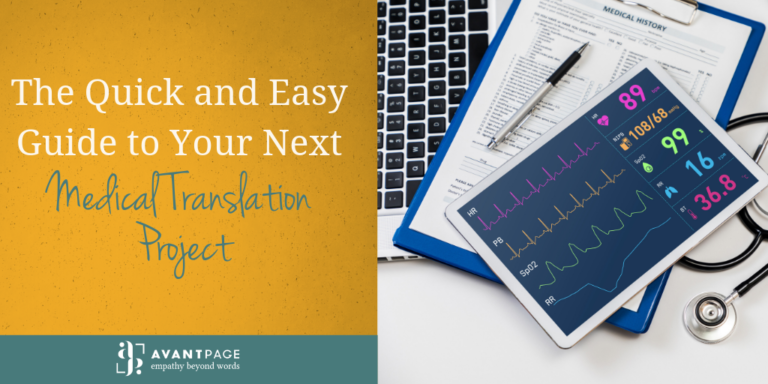
Translation projects involve a lot of moving pieces. The more informed you are on the translation process and how it works before you begin your medical translation project, the more likely it is that your projects will be successful and that you’ll be able to take advantage of savings opportunities. Once you’ve chosen a Language Service Provider (LSP) and met with your key contact, you'll provide the documents that need to be translated. Before your medical translation project begins, you may be asked to provide a glossary of standard terms or common names. If you have an English glossary, your LSP can help to translate this into your target languages as a great first step to ensuring accuracy and consistency across documents. If you have never used a glossary, now is the time to ask your LSP about the steps you need to take to create a glossary and other linguistic assets like a style guide. If you’re working with Avantpage, the next step is that we upload your original text into the translation management system, which breaks it up into segments. Our native-speaking linguistic team then translates and edits each text segment, and their work is saved in what we call a Translation Memory (TM). Your TM provides savings on your medical translation projects over time and can shorten the turnaround times on your translations. The actual process of translation is straightforward: the documents you send as part of your medical translation project will be translated by one of our certified linguists. Once the initial translation is complete, the translation will be seen by a different linguist who will edit the translation to ensure the accuracy of the translated work. Finally, your document will be sent to one of our proofreaders who will review the target text and ensure it matches the original message, tone, and is compliant with your style guide and glossary. Dependent on your organization’s goals with the medical translation project, you may require additional services. These can include: Written translation is most commonly charged by the word. The rate for your medical translation project will vary based on word count, complexity, and scope. The source language word count is generally used as a basis for the translation because the target language may differ in word count and space dependent on a variety of factors. The target language may be longer or more compact than your source language. For example, text in Spanish can take up 20% more space than the same text in English. Other elements that can increase or decrease the price of your medical translation project include language combination, formatting needs, urgency, and complexity. If you want to keep the costs of your medical translation project low, be sure to send the documents with plenty of time for translation and discuss your needs and your budget with your LSP. Like rates, the time a medical translation project takes depends on the project itself. A larger, more complex project will take longer than a simple one. Additional time is required for text that requires heavy formatting (DTP - Desktop Publishing) after translation. The time it takes to complete a medical translation project is heavily dependent on the length and complexity of your document. For projects of all sizes, you can ensure quick and efficient completion by compiling all the documents and data your LSP will need in advance. You should also be sure to send your documents in an editable format so your LSP won’t have to recreate them prior to beginning the translation. The more organized you can be, the more quickly the process will go. Each medical translation project is different, with varying timelines, costs, and needs. We can help you start your next medical translation project. Give us a call at 530-750-2040 or request a free quote today.

Everything You Need to Know About Translation Glossaries and Style Guides
Translation projects require time, attention, and planning. Each project is informed by the information you provide to your Language Service Provider (LSP), including any information you have about the purpose of the document(s), the document(s) themselves, and auxiliary documents like translation glossaries and style guides. In the translation industry, these are often referred to as “linguistic assets.” Translation glossaries and style guides allow your LSP to understand your translation preferences before they begin translating your document. Knowing these preferences can help to reduce the amount of time your translation project takes, as well as ensure consistency across your translated documents. A glossary, by definition, is a set of key terms and their definitions. A translation glossary provides these same key terms and definitions, but also includes their approved translations. Glossaries are particularly useful for industry-specific terms and consistent translation of repeated terms across your documents. A style guide lays out the standards of your organization when it comes to the style, tone, and document composition. Your style guide informs your LSP, and therefore your translators, about your organization's look, voice, and general identity. Additionally, this is a great place to address practical questions such as how to handle translating acronyms, and what words should be left in English. Creating and using translation glossaries and style guides has a variety of benefits to your translation projects and your organization as a whole. If you use glossaries and style guides, you can expect: The best way to create translation glossaries and style guides that benefit your translation projects is to work directly with your LSP. Their team can direct you as to what your glossaries and style guides should look like and, more importantly, what each should include. They’ll also share more information about glossary file formats that integrate with other platforms used by your LSP, including Translation Memory. If you want your glossaries and style guides to benefit your translation projects, you need to work with your LSP to create them in a way that is understandable and effective for everyone involved, from your internal team members to your dedicated Project Managers, and the individual translators working on your documents. Using glossaries and style guides will improve the overall quality of your translated documents, saving you time and worry. We can work with you to put together these linguistic assets for your organization. Give us a call at 530-750-2040 or request a free quote today.
Everybody Needs a Hero: Jameson's Hero Story
Everyone is a hero to somebody. Whether a big or small act, a single act or a repetitive act, an action that you’ve taken has certainly been seen as heroic. We are all, in some way, heroes to somebody else. Our employees are no different. They go above and beyond to help our clients, team members, and communities. The actions our employees take are certainly heroic in our eyes. That’s why we asked them to submit hero stories, stories in which they witnessed a team member take a step, or many steps, beyond what is expected to assist others and truly live our brand. Jameson’s hero story is one of many that illustrates the dedication of our team members to their work, and the dedication of our team members to living our brand. Jameson Hoscyns is the PHI Project Coordinator in our Davis, CA office. Jameson’s hero story directly impacts our clients and offers a solution to a significant translation issue. In September of 2018, Jameson was preparing a Burmese letter for delivery to our client. Our Proofing Department had caught a variety of issues in this letter, and Jameson was reviewing those issues to ensure the translated letter was delivered without errors. While he was reviewing this letter, he noticed that many of the errors that were present in the letter had to do with encoding corruption. After looking at the client’s Translation Memory (TM), Jameson noticed that the Burmese in the TM had encoding issues, and he set out to fix the issue. Jameson’s hero story continued with him pulling all Burmese Translation Memories hosted by Avantpage to check the encoding of each one. He set out to make a list of recommendations to address the encoding issues and prevent any future quality issues with the Burmese language. Jameson worked diligently to find a solution to this problem and brought it to the attention of our entire Ops+Quality team in order to effectively work through the problem and find an appropriate solution. Through these discussions, Jameson was able to fix the encoding issues within the Burmese language. In doing so, he greatly reduced the possibility of future Burmese translations being inaccurate and eliminated the encoding issue. Here’s what Einhorn Lopez, our Proofing Coordinator, had to say about Jameson’s hero story: “I think the most remarkable detail is that, despite the fact that we have never received any complaints about our Burmese translations, he cared about the quality of the work we deliver to our real customers, the people who need the translations.” Jameson not only helped to ensure a higher level of quality in our Burmese translations, but he also made those translations more accessible to those that will be using and interacting with them. Jameson’s hero story is a true testament to how much our employees care about the end-users of the translations we provide, and how dedicated our employees are to their work. We’re grateful to have such dedicated members as Jameson on our team, members who truly go above and beyond to provide empathy and opportunity to all people.

Want a Thriving Business? Focus on Healthcare Localization
Healthcare should be accessible for all populations, including those that are Limited English Proficient (LEP) and need language support. While translation on its own can support accessibility, localization can provide significantly improved access to healthcare for those with language needs. Healthcare localization projects can help you customize your products, services, and internet presence to reflect differences in distinct markets. It can also help you reach new markets and grow your healthcare organization. If your organization is in an area with many different language populations, healthcare localization can help you reach these populations more effectively than translation. While translation and localization may seem similar, localization is a much more involved process. In order to ensure that your documents will effectively reach your new target audience, your healthcare localization project will include localizing graphic design, color use, currency, symbols, and many other objects in your document. The goal of doing so is to effectively create a document that feels, reads, and looks like it was originally created for the language/culture group your organization is trying to reach. Healthcare localization can provide many different benefits to your organization. If your organization offers services that are of interest to non-English-speaking customers, either in the United States or the international marketplace, localizing your software, documentation, and website will help you connect with them on a whole new level. Presenting your organization as culturally and ethnically sensitive to the needs of your customers will differentiate it from the sea of healthcare providers. Not only that, but you’re also likely to see an increase in the number of clients or patients you see due to your localized content, as more of your target population will be able to fully understand the documentation you provide them. Your organization also stands to benefit more directly from healthcare localization projects. Localization helps polish your corporate image and increase your visibility as a trusted provider of medical services. You’ll also benefit from fewer misunderstandings as more of your target population will clearly understand what you offer as a healthcare organization. Almost 26 million people in the United States speak English “less than very well,” according to the U.S. Census Bureau's 2015 American Community Survey. These LEP communities make up a vast market of potential patients or clients that you can't afford to ignore. As more and more LEP populations opt to use the internet to gather information to aid their decisions, ensuring that your website is presented in a way your local markets can understand and respond to becomes critical. Localizing your website to reach LEP populations provides vital information to these populations about their healthcare choices. If you want a dynamic way to reach new patients or clients for your healthcare organization, healthcare localization should be top-of-mind. We can help you get started with your healthcare localization projects. Give us a call at 530-750-2040, or request a free quote to get started today.

7 Election Translation Activities You Should Take Now to Prepare for 2020
When the election is right around the corner and you need to get your ballots translated, you don’t always have time for key election translation activities that will help you to improve language access in your county. While it may seem early to start thinking about translating documents for the next election, completing a selection of translation activities now can save you time, money, and stress in 2020. Create an “election translation calendar”
An election translation calendar is a planning tool and should contain all relevant deadlines for your translation project. Note when you’ll need candidate statements, ballots, voter information guides, and other materials translated on the calendar. You can then use this calendar to work backward and determine what date you’ll need to send those documents to your Language Service Provider (LSP). Update your style guide
It’s a good idea to take a look at your style guide once a year and determine if any updates need to be made; the time between election cycles is perfect for this election translation activity. Indicate how you’d like your LSP to treat acronyms, abbreviations, organization names, proper nouns, and numbers. Update your vital documents
Any standard forms you’ll need for the election should be updated as part of your election translation activities. If your registration documents, signage, or other elections materials will be changing before the next election, update them as early as possible. Standardizing these documents and making the changes you need will prevent you from having to edit last-minute. Clarify communication roles
An easy way to streamline your translation projects is to assign a point-person for contacting your LSP. You should also make a clear list of team members who will need to be copied on translation-related communications, and determine who will be responsible for making translation decisions. Research your language communities
Researching the language communities in your area is a good way to ensure that you’ll be prepared to translate into any new threshold languages. Talk to your local community leaders about the languages and dialects used by your constituents to ensure you’ll meet their needs. If you anticipate new threshold languages as part of your election translation activities, you’ll be better prepared to provide those translations to your constituents. Consider whether you’ll need DTP formatting services
If your documents would benefit from formatting services, now is the time to be gathering the files needed to pursue DTP services. Gather the original, editable files of your documents, graphics, and any additional material your LSP will need. Organize your internal translation review team
If you want to review your translations internally after they’re completed by your LSP, now is the time to put together your review team. Be sure your review team is qualified and trained on how to review the translations. If you aren’t sure how to train or certify your bilingual employees, your LSP can assist you in doing so. You’ll also want to inform your internal editing team of the kind of edits they should be making, and in what way they should be making those edits. If you tackle these election translation activities before the next election cycle, you’ll be prepared to meet the language needs of your constituents. Download our quick guide to these 7 activities and keep it with you as you plan for 2020. If you want help preparing for your election translation projects, call us at 530-750-2040 or request a free quote today.

8 Questions About Translation You Need to Ask a Potential LSP
If you’re new to the translation industry, it’s likely that you have questions about translation, translation processes, and everything in-between. That’s great! You should be asking these questions before you decide on an appropriate Language Service Provider (LSP) for your translation projects. Every LSP has different methods of translator recruitment, different translation processes, etc. If you want to find the right LSP for you and your organization, ask these questions and see how well their answers match what you’re looking for. What range of language services do you offer? LSPs provide language services from translation to localization, interpreting to ADA compliance. Ask your potential LSP what services they offer so you can be sure they’ll be prepared to meet your needs. If you have a website localization project in the future, will this LSP be able to complete that service? What does your translation process look like? Does the LSP go through a three-step translation, editing, and proofreading (TEP) process? Who will be editing and proofreading your translations? One way to ensure you end up with a quality end product is to ask questions about translation processes and ensure they produce the level of quality you’re looking for. How can my organization submit edits to translated documents? Not every organization wants to review their translations after their LSP has sent them. However, if you do, and you have an internal translation review team prepared, be sure to ask questions about translation edits, best practices for submitting them, and how they’ll be integrated. What language technologies do you use? In this digital age, there is a wide variety of translation technology that can support the work of an LSP. Ask about the kinds of language technologies they employ and be wary if they say they use machine translation. Technology is helpful, but linguists should be completing your translation projects to ensure the nuances of language are appropriately attended to. Will you help my organization to create a style guide and glossary? Style guides and glossaries tell the linguists who work on your projects how you want certain terms translated, what the tone of the translation should be, what terms to avoid translating, and much more. Having a style guide and glossary helps to ensure the consistency of your translated documents. Do you use Translation Memory? Translation Memory is one of many translation technologies that are used by LSPs. This particular technology reuses past translations to increase efficiency. When your translation project is completed, the language from the original (or source) document is stored along with the language from its translated counterpart in a secure database. Having a Translation Memory can decrease the amount of time and money you spend with a translation project, so this should certainly be one of your questions about translation technology. How do you recruit the translators who will be working on our projects? Asking about the recruitment process for translators can ease your mind and help you to determine what the quality level of your translated documents will be. What are the requirements for a translator to be considered? Do the linguists need to be affiliated with professional translation associations? Do they have degrees, references, etc.? Do you test your linguists before they begin working with you? If so, how? Testing linguists through verbal or written exams supports higher quality translations. If the linguists working with your potential LSP have been tested, and they passed that test, you can feel confident they’ll be able to handle your translation requests. While there are other important questions to ask a potential new translation partner, this list will get you on the right path to finding an LSP that works effectively with your organization. If you’re looking for a new LSP, give us a call at 530-750-2040 or request a free quote today. We’d be happy to answer these questions for you!

Developing Your Language Access Plan: Planning for Translation Made Easy
Planning for translation, whether you’re new to translation or not, takes time, energy, and resources. While planning for translation may seem like an overwhelming task, there are processes that make it easier. Creating a Language Access Plan and answering a few questions for you and your team before your next translation project can help to ensure success. Planning for translation includes setting up a Language Access Plan for your healthcare organization. A Language Access Plan, simply, is how you plan to approach the needs of LEP patients regarding language services. While it is legally required by federal regulations, it also presents an opportunity to ensure that you’re providing the best possible care to LEP populations. There are four factors that you need to analyze as you move towards creating, or amending, your Language Access Plan: Throughout the planning of your Language Access Plan, return to this question: “Am I providing meaningful language access to those who need it?” Your Language Access Plan should include at least three items which will help you in planning for translation. These items include: When creating your Language Access Plan, it’s recommended that you begin to identify how you’ll handle document translations as well. While this isn’t a legally require part of your Language Access Plan, it is a legally required service you must provide as a healthcare organization. Ask yourself the following questions: Most importantly, when creating your Language Access Plan, you need to be considering the languages of your population. The top 15 languages in your area are the languages you need to be translating your documents into. Any language that has a population of speakers equal to or greater than 5% you’ll need to provide interpretation services for. Outside of creating your Language Access Plan, planning for translation includes a variety of other tasks. This involves asking yourself a series of questions: If you dedicate time and resources to planning for translation, you’ll be much more likely to see success from your translation projects. If you want guidance on creating your Language Access Plan or planning for translation, call us at 530-750-2040 or request a free quote today.