
Common Components of a Language Access Plan
In the U.S., language access helps ensure that people with Limited English Proficiency (LEP) or other communication challenges can access essential information and services. Effective language access can reduce communication barriers and support more equitable access for historically underserved communities.
Over time, laws have been put in place to address language access. Some of the federal laws that pertain to language access include:
- Title VI of the Civil Rights Act of 1964 – prohibits discrimination on the basis of race, color or national origin (speaks to language).
- Americans with Disabilities (ADA) Act 1990 – includes language access that involves communications for individuals who may be deaf, hard-of-hearing, blind or have other disabilities.
- Executive Order 13166 – in 2000, President Clinton signed an executive order that requires federal agencies to develop a systematic plan for meaningful for LEP individuals.
So, what is a language access plan? A language access plan is a policy that outlines how an organization will provide language access services to people who may face communication barriers, including those who:
- Non-English speaking
- Have LEP
- Have a visual impairment
- Are deaf or hard-of-hearing
- Have other challenges that make it difficult to communicate
A language access plan serves as a blueprint for an organization’s approach to meaningful communication with people who need additional language support. It may include translated materials, interpreting services, alternative communication formats, and internal procedures. For schools, healthcare providers, government agencies, and other organizations serving LEP communities, a clear language access policy can help guide consistent and accessible communication.
While there isn’t a single method to follow, we have identified common components. We’ll share those in this blog.
Common Components of a Language Access Plan
Based on publicly available government agency plans, organizations typically include the following core components in a language access plan.
Needs Assessment
The first section is usually a needs assessment that explains how an organization will evaluate the language assistance needs of the communities it serves. This assessment helps shape the organization’s language access policy and can draw on several sources, including:
- Internal customer satisfaction surveys
- 2020 census results
- American Community Survey results
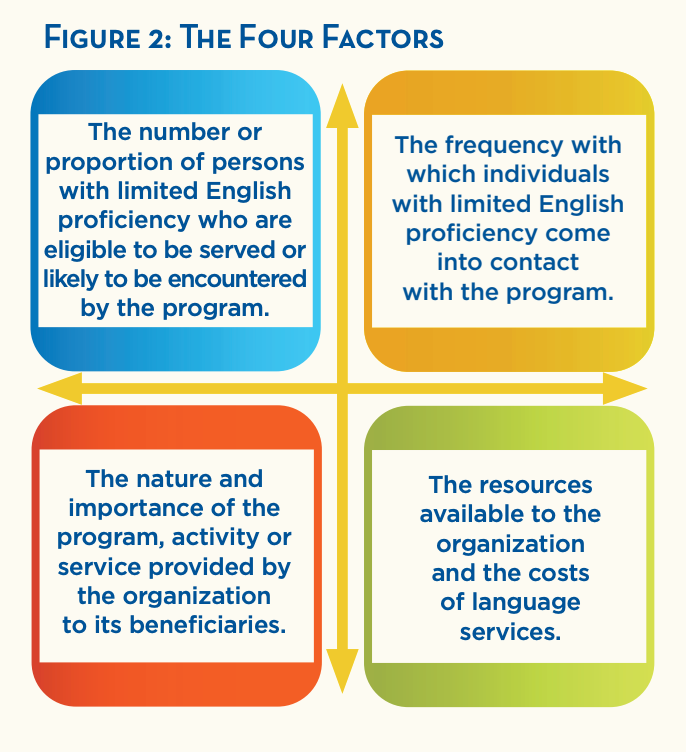
- Four Factor Analysis
- For other resources, look at the Centers for Medicare and Medicaid’s Inventory of Resources
- Other local resources such as health services, non-profit organizations, and others
Based on these findings, the organization can determine the scope of language access services needed and identify the languages, formats, and resources required to serve its communities effectively.
Language Access Coordinator
A designated language access coordinator is responsible for overseeing the organization’s language assistance needs and supporting the implementation of its language access plan, including:
- Developing the language access plan
- Training staff on the organization’s policies and procedures to ensure the integrity of the plan, and reiterate the organization’s mission. Those who work directly with customers and service providers should receive additional training on how to coordinate and communicate the services effectively
- Communicating the organization’s strategy and capabilities
- Managing language assistance services
Partnerships and Other Ties to the Community
In addition to the language needs section, this part of the language access plan identifies community leaders, stakeholders, and organizations that work with LEP individuals or communities. These partnerships can provide feedback, help assess quality, identify priorities, and offer insight into community experiences and language needs.
Interagency, Liaison or Working Group Cooperation
Provide names of advisory committees, working groups, forums, resource sharing, and partnerships with other agency networking options to gain insights, information, tactics, and pool resources.
Meaningful Marketing, Information, and Communications in Print and Online
Add information dissemination methods that reach multiple channels in print, digitally, onsite or otherwise. Participate and partner with organizations, programs, events, public meetings, key community stakeholders, social media, and more to ensure the communities have the information.
Quality Control
Define how the organization will monitor the quality of its language access services. This may include internal audits, reviewing provider data on complaints and turnaround times, gathering community feedback, and having stakeholders or working groups review translated content for accuracy. The plan should also address onboarding, data tracking, partnerships, customer feedback, and the maintenance of linguistic assets.
Tracking and Reporting Data
Describe how your organization will track language service usage over time, including primary and secondary languages and initial data from LEP individuals. This information can help evaluate the effectiveness of the language access plan and identify changes in community language needs over time.
Additional Components to Consider
Additional components that may be included in a language access plan, depending on the organization’s needs, include:
- Multilingual planning for disaster/emergency preparedness
- Resource utilization to include who is involved with language assistance and tracking effectiveness
- Budgeting approaches
- List any centralized internal contacts for language services such as the LEP coordinator, language services procurement official, or otherwise.
- Clear descriptions of the types of language services provided
- Clearly identify each vendor’s Project Manager for placing language service requests
- Information on obtaining a language service provider (LSP) vendor through procurement and purchasing
- Information on the use of plain language
- Information on the inclusion of digital literacy efforts
Conclusion
The contents of a language access plan vary by organization, since each plan should reflect specific communication needs, audiences, and available resources. However, the components outlined in this article are commonly included in effective plans.
To learn more about how Avantpage can support your language access plan and related language access services, contact us at info@avantpage.com or (530) 750-2040.
To learn more about how we can help you with your language service plans, contact us at info@avantpage.com or (530) 750-2040.