Measuring Success: KPIs That Show the ROI of Inclusive, Multilingual Outreach
If you want to make sure your services are accessible to as many people as possible, multilingual outreach is pretty much non-negotiable. After all, if people with limited English proficiency (LEP) don’t know about your services or how to use them, they can’t fully benefit from what you offer.
This is why multilingual outreach campaigns are so important—they ensure that people with LEP are informed about critical services, from healthcare to government. Launching outreach campaigns in multiple different languages allows you to tap into diverse populations and expand your scope.
As with any sort of communications or marketing process, it’s important to track the success of your multilingual outreach efforts. In this blog post, we’ll identify several key performance indicators (KPIs) that you can use to assess the ROI of your multilingual outreach efforts. We’ll also look at some strategies to boost these KPIs and improve your work if you find that you’re lagging behind a bit.
Table of Contents
What Is Multilingual Outreach?
Why Measuring ROI Matters for Multilingual Outreach
Key KPIs to Track the Effectiveness of Multilingual Outreach
Calculating Your Return on Investment
How Technology Supports Measuring Multilingual Outreach ROI
Best Practices for Continuous Improvement
What is Multilingual Outreach?
Multilingual outreach is any form of coordinated communication campaign that’s delivered in multiple languages to reach a diverse group of members. Take, for example, a social media marketing campaign: In addition to launching ads in English, a multilingual outreach campaign would also feature translations (or transcreations) of those ads targeted to users whose primary language is not English.
Multilingual outreach encompasses a wide range of different media—from print media like letters, informational brochures, and paperwork to digital media like email, text messages, and phone calls. Pretty much any form of communication that your organization sends out can be localized into different target languages to create a multilingual outreach campaign. In doing so, LEP individuals—who make up nearly 10% of our country’s population—will better understand what your organization does and will be more inclined to actually take advantage of your services and programs.
Why Measuring ROI Matters for Multilingual Outreach
Just like any other communication effort, measuring the ROI of your multilingual outreach will allow you to understand where your organization is doing well and where you can improve.
Measuring ROI gives you a better sense of where your resources need to be allocated—perhaps you want to invest more time and money into your multilingual outreach efforts. Maybe you’re even thinking about hiring full-time staff members to oversee language access projects. If you’re able to show that your multilingual outreach efforts have increased engagement and generated revenue for your organization, you’ll be more likely to convince key stakeholders of the value of investing these resources into multilingual outreach.
Additionally, multilingual outreach may also be a factor for regulatory compliance, depending on your industry. Particularly in healthcare and government, regulations like the ADA and Section 508 mandate certain language access standards, making effective multilingual outreach an absolute must-have.
Key KPIs to Track the Effectiveness of Multilingual Outreach
While multilingual outreach can be costly—high-quality translations aren’t free, after all—it’s worth the investment, thanks to the increased engagement and member satisfaction it tends to drive.
In this section, we’ll take a look at six different KPIs you can use to track the effectiveness of your multilingual outreach efforts.
KPI 1: Member Engagement Rates
To gauge member engagement, you can look at the following metrics:
- Portal logins
- Click-throughs
- Email open rates
- Attendance or participation rates in programs, screenings, appointments, etc.
A well-done multilingual outreach campaign should lead to an increase on all of these metrics.
KPI 2: Comprehension & Accuracy
There are a couple of ways to measure comprehension and accuracy. First, you can conduct a survey that directly asks members about the comprehensibility of your communications and marketing efforts. Another way to do so is to look at the rate of errors and misinterpretations members make when interacting with your office—for example, you can compare the number of errors on paperwork members made before and after you translated said paperwork into different languages.
KPI 3: Member Satisfaction
To look at member satisfaction, you can use the net promoter score (NPS) or conduct satisfaction surveys. Satisfaction surveys should ask members for feedback on clarity, relevance, and the accessibility of your messages.
KPI 4: Program Participation & Compliance
Multilingual outreach campaigns should boost participation in relevant programs; look at the participation rates of members from different linguistic backgrounds in certain programs. For example, if you put out ads in Spanish and Chinese for a wellness program, expect to see higher participation rates among Spanish and Chinese-speaking members.
KPI 5: Operational Efficiency & Cost Savings
Successful multilingual outreach will likely reduce call volume, as members are less likely to misunderstand the communications they receive from you. As time goes on, you may end up saving time and money as you spend less on correcting errors, translating, and re-issuing communications.
KPI 6: Equity & Inclusion Metrics
Track engagement, utilization, and outcomes among LEP members over time to determine whether multilingual outreach is successfully reducing access gaps. Compare performance not only to English-speaking members, but also to each group’s historical baselines and known structural barriers.
Calculating Your Return on Investment
By tracking these KPIs and more, you can easily calculate your return on investment in multilingual services. Here are just a few simple formulas you can use to calculate the return on investment of multilingual outreach efforts. Using the table below, fill in your past and current (after updating your multilingual outreach strategy) metrics to estimate time and cost savings:
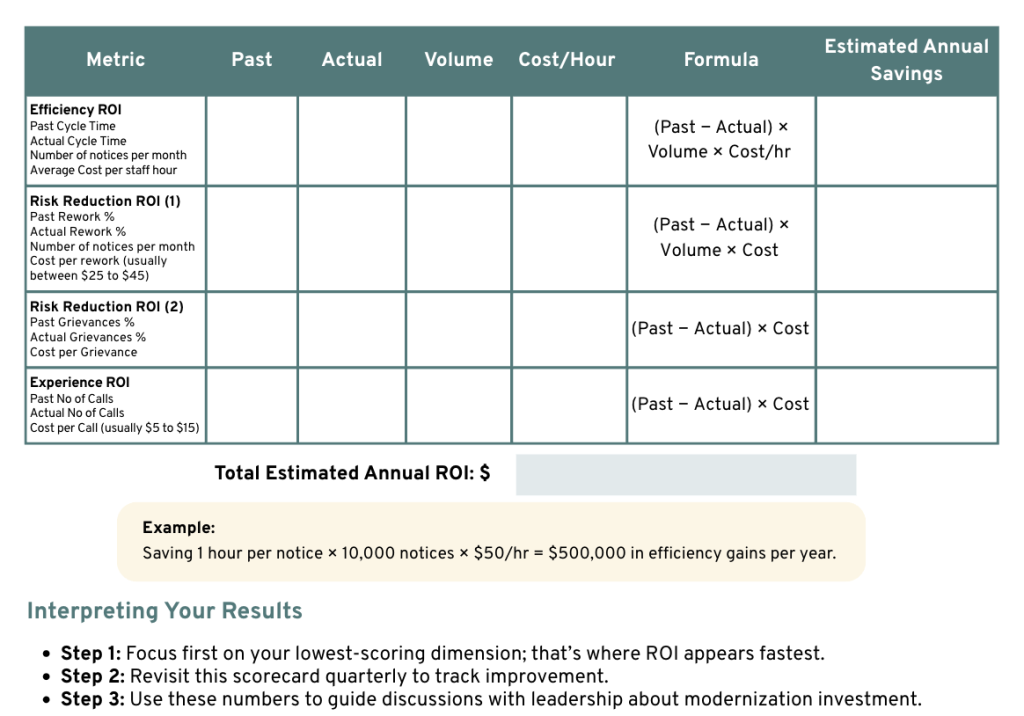
For example, let’s say you’re calculating Experience ROI—perhaps your phone operators field 900 calls per month from LEP members. If you implement a thorough and clear multilingual outreach strategy that cuts those calls down to 400 per month, you can expect to save anywhere from $2,500 to $7,500, depending on how much each call costs you.
Want to learn more about how to boost your organization’s efficiency and savings? Check out this recording of our webinar, “Modernizing Member Communication Workflows.”
How Technology Supports Measuring Multilingual Outreach ROI
Technology makes it much easier to measure the ROI of multilingual outreach with accuracy and consistency.
Platforms like AvantSend centralize multilingual and accessible communications, offering integrated reporting and real-time dashboards that surface engagement, compliance, and member feedback across languages. Instead of relying on scattered reports or delayed data, you can see how campaigns perform the moment they launch and quickly spot where outreach is resonating—or falling short.
Automation further streamlines the process by reducing manual tracking and ensuring that messages go out accurately and on schedule. These workflows minimize errors, improve data quality, and give you a clear, reliable view of how effectively you’re reaching LEP members.
Best Practices for Continuous Improvement
Effective communication doesn’t end with one or two messages—it’s a continuous process that needs to be adjusted over time to ensure clarity. Organizations should strive for constant improvement in their multilingual outreach efforts, and measuring the above KPIs can help you adjust your approach accordingly. Below are some best practices to use these KPIs for continuous improvement:
- Collect feedback and use it to refine your messages, channels, and languages.
- Benchmark KPIs regularly against internal and external standards.
- Train staff on inclusive communication and cultural competency.
- Integrate multilingual outreach into a broader engagement strategy.
Frequently Asked Questions About Multilingual Outreach
How do I know if my organization needs multilingual outreach?
If your organization interacts with populations from different linguistic backgrounds in any sort of capacity, it’s a good idea to launch multilingual outreach campaigns. Additionally, if your organization provides healthcare, government, or legal services, state or federal regulations likely require some sort of multilingual outreach efforts.
How much does multilingual member outreach cost?
This depends on several factors, such as:
– The size and scope of your multilingual outreach efforts
– The language service provider you work with for translation and localization
– The languages you need your content translated into (low-resource languages tend to be more expensive)
– Whether or not you use machine translations or other technological solutions
Your best approach is to consult several different language service providers to get a quote for your project and determine which option is right for you.
What are some examples of multilingual outreach projects?
Here are a few examples of multilingual outreach campaigns:
– A social media advertising campaign that’s translated into multiple different languages and targeted to speakers of each language.
– A customer service hotline that allows members to speak with a representative in their preferred language (instead of just English).
– Discharge papers and care instructions translated into a patient’s preferred language.
ROI You Can Measure: The Power of Multilingual Outreach
When done well, multilingual outreach delivers measurable, repeatable results.
By tracking clear KPIs, you can see exactly how your efforts improve engagement, strengthen equity, and make services more accessible to all members, regardless of their linguistic background. Gauging your performance based on these metrics can turn a basic compliance requirement into a strategic advantage, showing where outreach is succeeding and where targeted improvements can drive even greater impact.
Avantpage offers a streamlined way to manage, track, and evaluate multilingual outreach. With tools like AvantSend, we help teams understand the true ROI of their efforts and confidently scale what works. If you’re interested in learning more about how our translation services can help you expand your reach, contact us online, email [email protected], or call (530) 750-2040.
Interested in learning more?
Watch the full webinar and download our free workbook about how healthcare organizations can identify areas of improvement for multilingual member communication workflows and how to calculate ROI.