
Blogs

The Hidden Benefits of Healthcare Translations
Healthcare translations are an incredibly important part of ensuring the safety and satisfaction of all of your patients or members. Just to clarify, when we’re talking about translation, it refers to the conversion of written text from one language into another. The translated text reflects the content of the original text but also aligns with the culture, customs, and language of the new target audience. The linguists who translate your documents examine the context of your document and the core message you’re communicating in order to make the translated document valuable to your users. Another key component of serving your Limited English Proficient (LEP) audiences is interpretation, in which the spoken word is converted into another language in real-time. Communicating with your members or patients in the language they speak on a day-to-day basis is mandated for the healthcare sector. The laws and regulations that apply to healthcare each set out guidelines surrounding who can translate your documents, as well as what documents you need to have translated. However, there are many other reasons that translation is a service you should employ as a healthcare organization. In the United States, there are roughly 25 million Limited English Proficient (LEP) residents. They speak languages other than English and may have limited or no knowledge of the English language. Due to this, LEP residents are frequently left behind and have limited access to the services and accommodations needed to improve quality of life and health. Multiple studies have been done that show a lower level of care quality for LEP people as they seek healthcare services. The Journal for Healthcare Quality has recently published a study stating that LEP patients face more medication errors and lack of informed consent because interpreters weren’t used by staff in all cases. The American Academy of Pediatrics discovered that LEP patients are more likely to suffer from adverse events and longer hospital stays once they are admitted. There’s an easy way to reduce these negative outcomes that come from misunderstanding. By improving your language access plan, and ensuring your translation are high-quality and accurate, you can increase the safety and satisfaction of your LEP patients, clients, and members. Beyond that, the International Customer Management Institute (ICMI) reported that adding language services to a healthcare organization not only improved satisfaction with customer support but also that it increased loyalty to the organization overall. Improving, or instituting, your language access plan is only beneficial if it takes into consideration the needs of your patients, clients, and members. If documents are translated poorly, LEP patients are likely to lose confidence in your ability to treat them. Similarly, if your interpreters are not available when they need to be, LEP patients will, again, lose confidence and may even allow their healthcare concerns to take a back seat out of frustration. The key to instituting or improving your language access plan so it can be successful is to ensure the healthcare translations you provide are of the highest levels of both quality and accuracy. When provided, high-quality translations increase the social value of your organization, while also ensuring that you’re compliant with all healthcare regulations. In order to get high-quality, accurate healthcare translations, you’ll need to hire an experienced and specialized medical Language Service Provider. The translations that you receive from a professional Language Service Provider are culturally aware, industry aware, and inclusive of your audience. We can help you increase the safety and satisfaction of your LEP patients, clients, and members, as well as increase the reputation your healthcare organization holds in the community. Get started with your translation project today, give us a call at 530-750-2040 or request a free quote.
New to Education Translation Projects? Here's What You Need to Know
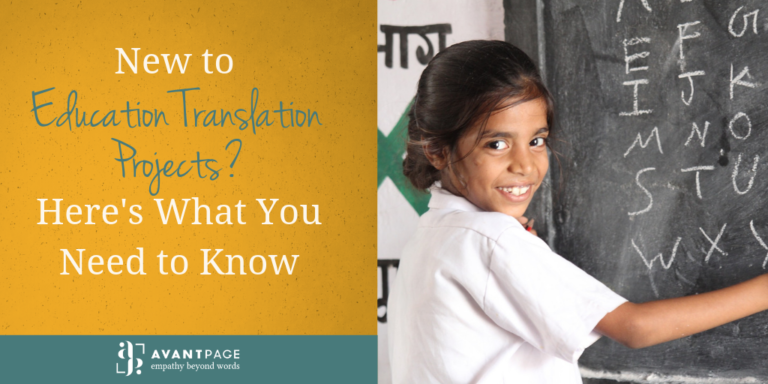
At every level of education, there is a need for translation. Regardless of the age of your students, or the role your office plays in the education process, regulations demand that education materials are translated to give meaningful access to Limited English Proficient (LEP) students and parents. Education translation projects allow for higher levels of engagement in public education, while also presenting your organization as an inclusive space where all people are welcome. Regulations surrounding education translation projects, like Title VI and Executive Order 13166, refrain from defining what documents your organization needs to translate. Rather, the relevant regulations mandate that your organization must offer meaningful access to education for all populations in your area. If you aren’t sure where to start with translating your education documents, here are some of the most common education translation projects we complete. While there is no defined list of documents that each individual school must translate, there are documents that should be accessible to any student or parent that may come in contact with your school. Those documents include: If you aren’t sure where to start with your education translation projects, ask yourself what documents are most frequently viewed by students, parents, and community members in your area. If those documents aren’t already translated and accessible to LEP populations, you should look into hiring a professional Language Service Provider to remedy the situation. Your school district is the face of public education for your immediate area. Offering translated documents can improve support of your school district while also offering access to events, initiatives, and communications that a portion of students and parents in your area may not otherwise have been aware of. These are a few of the documents that you may find beneficial to translate: Again, the most important aspect of starting education translation projects is to ask what documents the native-English-speaking parents and students in your area have access to and translate those documents first. It may also be beneficial to determine what non-English languages are spoken by your population to determine what languages you’ll need to translate these documents into. While universities and other higher education organizations may see less need for translation services, there are many benefits that can come from education translation projects. Your higher education organization can project inclusivity, recruit more international students, improve your public image, and solicit funds from international donors through the employment of translation services. Here are some documents you may consider translating: Your Department of Education is the face of education in your state, setting the tone for all districts and schools in the area. By stepping in and translating your documentation, you encourage the universities, districts, and K-12 schools in your area to do the same. Not only does this promote an image of inclusivity, it provides meaningful access to education that LEP students may not otherwise have. There are many different documents your Department of Education should consider translating: While federal regulations don’t directly state which documents your education organization needs to translate, translating the documents in these lists can positively benefit your education organization, students, parents, and community members. If you’re still unsure where to start with your education translation projects, give us a call at 530-750-2040, or request a free quote today.

5 Halloween Traditions From Different Countries You Need To Know
Wearing creative costumes, going door-to-door for candy, exploring haunted houses—these are some of the Halloween traditions in the United States. However, the way the US celebrates Halloween is the conglomeration of how other countries celebrate Halloween in accordance with their traditions and celebrations. Modern Halloween has its roots in Irish and Scottish Halloween traditions. The origins of Halloween can be traced to the ancient Celtic festival Samhain. The Celts celebrated the new year on the first of November, signifying the end of summer and the beginning of winter. The last day of October was the day when the boundary between the living world and the dead world blurred, and ghosts could return to Earth. To this day, the Irish and Scottish people maintain this Halloween tradition by building sacred bonfires, wearing complex costumes, fortune-telling, and consuming traditional desserts. Mexico doesn’t celebrate Halloween, and instead celebrates El Día de Los Muertos or “Day of the Dead.” At midnight on Oct. 31, the souls of deceased children return from heaven and reunite with their families on Nov. 1. The souls of deceased adults return on Nov. 2 to reunite with their families as well. Altars decorated with flowers, candles, and traditional foods are built in family homes to honor the deceased loved ones. The celebrations go from home to the graveyard, where people gather to have picnics and celebrate/connect with the loved ones that have been lost. England has only recently started celebrating Halloween with the same fervor as other countries. Their celebrations are based in pagan festivals, similarly to the Halloween traditions of Scotland and Ireland. When Halloween first started being celebrated by England, people wore costumes when venturing outside to avoid being harmed by spirits that had returned to Earth. Now, many of the Halloween traditions in England are the same as those in the United States and people engage in trick-or-treating, watching horror films, and wearing fun costumes. China’s Halloween celebrations aren’t held on Oct. 31. The most popular celebration in China is The Hungry Ghost Festival, which falls on the 15th day of the seventh lunar month—generally in the middle or end of August. This is the month when spirits, particularly restless ones, roam the Earth. The Chinese people make offerings to appease these ghosts while also paying tribute to their ancestors. Many of their celebrations involve bonfires, where they burn fake money and other offerings to the spirits so they may use them in the afterlife. Food is also left as an offering to ensure the ghosts do not go hungry in the afterlife. Halloween isn’t recognized on the calendar in Poland, but they still have Halloween traditions. While modern celebrations of Halloween are gaining traction, Poland really celebrates its traditions on the first and second days of November. These two days are national holidays: All Saints’ Day and All Souls’ Day. The Polish people travel to where their relatives were buried and gather to pray for the loved ones they’ve lost, as well as talk about all the good things their loved ones did. Halloween traditions are as variant as the people who celebrate them, but all of these traditions borrow from one another. When cultures converge, incredible things can happen. What are your Halloween traditions? We’d love to hear about how you and your culture celebrate Halloween!

Do You Need To Hire A Translator?
There are many times when your business will need to hire a translator. The most obvious situation is when some specific laws or regulations require translation. In this situation, a professional translator is vital to ensuring the accuracy of your translation. However, hiring a professional translator can also help you reach new audiences, grow your business and make your life easier. Here are three ways the decision to hire a translator is the right one. When you hire a professional translator from a Language Services Provider (LSP) such as Avantpage, you get more than just one person—you get an entire team of people dedicated to making your life easier. From the project manager to the account manager to the linguist to the proofer, each person on your translation team is focused on ensuring the quality of your translation at each step of the process. Sometimes organizations try to save money by asking bilingual employees to help translate various documents. However, this decision can cost you time and money in various ways. When you hire a translator through an LSP, you can be confident that you are working with a professional who values accuracy. At Avantpage, we consider more than 40 pieces of information to ensure you get a high-quality translation that serves you and your consumers. Expanding language access to new audiences and customers can help you grow your business. For example, did you know that translation can help Limited English Proficiency (LEP) homebuyers overcome barriers to homeownership? In addition, translation of internal documents can help engage your LEP employees and boost productivity and results. If you hire a translator, you can translate the necessary documents to see business growth in multiple ways. When you hire a translator, you protect your organization’s credibility and its future. For more information about working with our high-quality translators, give us a call at 530-750-2040 or request a free quote today.
Yes, You Need to Increase LEP Patient Safety and Satisfaction
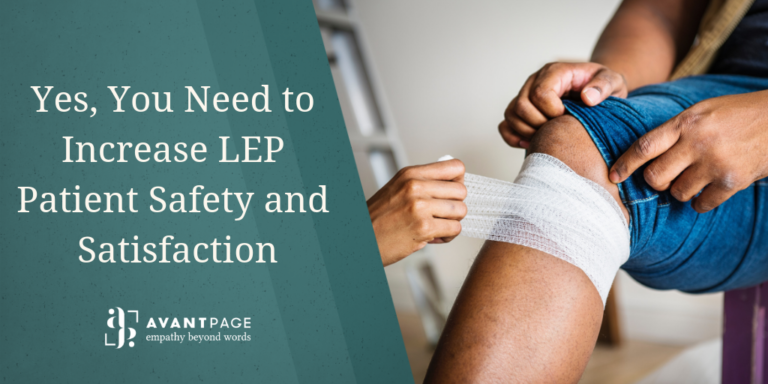
Limited English Proficiency (LEP) patient safety and satisfaction are directly correlated with the quality of your document translations. As your translation quality increases, LEP patient safety and satisfaction does as well. So, while translation services are mandated and heavily regulated for the healthcare sector, there are benefits to healthcare translation that go far beyond compliance. About 25 million LEP individuals live in the United States. These residents speak languages other than English and may have limited or no knowledge of English. Due to this, this population experiences limited access to services that English-speaking populations can access. LEP populations continuously report lower satisfaction with the healthcare system and lower quality of care when seeking health services. Quality of care issues stem from ineffective or indirect communication and result in higher medication errors and uninformed consent, which decrease LEP patient safety and satisfaction. These issues affect LEP patients of all ages and statuses. The American Academy of Pediatrics discovered that pediatric LEP patients are more likely to suffer from adverse events and longer hospital stays once they are admitted. The key to improving LEP patient safety and satisfaction lies in translation. Improving the accessibility of your healthcare organization through meaningful translation decreases risk and increases patient satisfaction. Many of the avoidable risks of treating LEP patients are caused by miscommunication. If your patient doesn’t understand what they’re being treated for, discharge instructions, or other vital health information, treating them creates significant risk and can result in readmission in hospital settings or revisits in clinic settings. Similarly, if your patient cannot effectively communicate current health concerns, underlying health issues, medication allergies, or other vital information, the risk of adverse outcomes increases. Translation of vital healthcare documents allows your patients to understand exactly what you need to know to treat them effectively, which improves health outcomes. In improving health outcomes, patient satisfaction also improves. With fewer medical mistakes and more direct communication, LEP patients report higher levels of satisfaction with their medical care. This benefits these patients, gives your healthcare organization a better public image, and can increase the number of referrals you receive. You’ll need to hire an experienced and specialized healthcare Language Service Provider (LSP) to ensure your translations are high-quality and accurate in any language. If you want to increase LEP patient safety and satisfaction give us a call at 530-750-2040 or request a free quote today.

Federal voting regulations are determined to increase voting accessibility for those with limited English proficiency. Support them through translation.
Parents and families of all language backgrounds can positively impact their children’s education, and this is equally true for limited English proficient (LEP) parent engagement. However, relative to English-speaking parents, LEP parents have lower rates of attendance at general school meetings, parent-teacher conferences, or school or class events and lower rates of volunteering or serving on a committee, according to the National Household Education Surveys. To promote LEP parent engagement at your school, help these families see themselves as active participants in their student's learning. When a student’s parents or guardians become involved in his or her education, the student can see important benefits. Parent engagement can improve a student's academic achievement, behavior, attendance, social skills, and mental health. For LEP parents, engagement in their children's education can provide an excellent introduction to American society and increase their awareness of other community services available to them. There are many ways parents or guardians can become engaged with their student's education, including: For LEP parents and families, parent engagement in the school process can be a new cultural concept. Attempts to foster LEP parent engagement can often be interpreted as a call for interference. Many LEP parents believe that the school has the qualifications and responsibility to educate their children, and that parent engagement can be counter-productive. As a result, it's essential to explain the benefit of parent involvement to LEP parents. One of the most critical steps to cultivating LEP parent engagement is to eliminate barriers to involvement and provide an inclusive, collaborative environment. To remove barriers to LEP parent engagement, offer bilingual community liaisons to bridge language and cultural differences. The bilingual community liaison should be a highly respected member of the parents' language community who is knowledgeable about the American school system. Another way to facilitate LEP parent engagement is to use a good translation process. When LEP parents and guardians are provided with documentation they understand and connect with, they're more likely to get involved with their student's education. By increasing LEP parent engagement, you can help students improve their academic achievement and become more motivated students. If you don't have a translation process that creates meaningful access for LEP parents and guardians, call us today at (530) 750-2040 or request a free quote. We can help you increase LEP parent engagement in your school or district.
Voting Accessibility and Language: Everything You Need to Know
With more than 25.1 million Limited English Proficient (LEP) individuals ready to vote in elections, a key part of your election planning must be considering voting accessibility. While voting accessibility includes a wide variety of topics, the most impactful for LEP individuals is language access. Your LEP constituents need voting materials they can connect with and understand without issue. The federal government supports the needs of LEP individuals by setting regulations for translation and interpretation to support voting accessibility. These regulations apply all the way from voter registration to election day to ensure LEP individuals can engage with the democratic process. Your county needs to translate documents for specific groups based on their percentage of the population in your area, or literacy rate. Your county needs to translate documents for minority language groups that: An additional requirement is that your polling place must staff bilingual workers for the affected minority language groups. ADA populations have their own voting accessibility requirements. All counties must meet the ADA voting accessibility requirements to ensure ADA individuals have access to participate in the democratic process. To maintain compliance with ADA voting rights, your county needs to provide braille-formatted materials at the polls, including ballots and voter instructions. Audio devices that provide meaningful access to the information being read must also be available at your polling place. Finally, for ADA-covered individuals, you must be willing to provide in-person support to those that are voting, including reading ballots and voter instructions aloud. If you’re worried about the status of your county’s translations, or just want to make sure you’ve translated all of the necessary documents to remain compliant, give us a call at (530) 750-2040 or request a free quote. We can help you get and stay compliant with all federal voting accessibility requirements.

Translating Protected Health Information: What You Need To Know
Translating protected health information may be top of mind for you if you work for a healthcare or health insurance organization. Most of all, you may wonder how your Language Service Provider is translating protected health information (PHI) while following the appropriate regulations and ensuring confidentiality. The security of your patients' or clients' protected health information should be a high concern for you and your LSP. At Avantpage, we follow best practices when translating protected health information by using many processes and technologies. The Health Insurance Portability and Accountability Act (HIPAA) prohibits the unauthorized sharing of medical records and personally identifiable information without patient consent. This protected health information is often shared during the delivery of translation services and should be handled carefully by vendors for a covered health care entity. Because they are not employed by the organization using their services, translators are considered business associates under HIPAA legislation. Patient information should only be shared with a business associate for a specific purpose as stated in a business contract between a provider and hospital or clinic. To fully comply with HIPAA regulations, your LSP should incorporate the following: The most important step your organization can take when translating protected health information is to hire a professional translation company with experience in the healthcare field. Make sure to assess potential vendors carefully and continually monitor their adherence to the laws. Protected Health Information is essential, and your LSP should treat it that way. If you'd like to learn more about our data safety protocols at Avantpage, give us a call at 530-750-2040, or request a free quote.
Everything You Need to Know About Healthcare Translation Projects
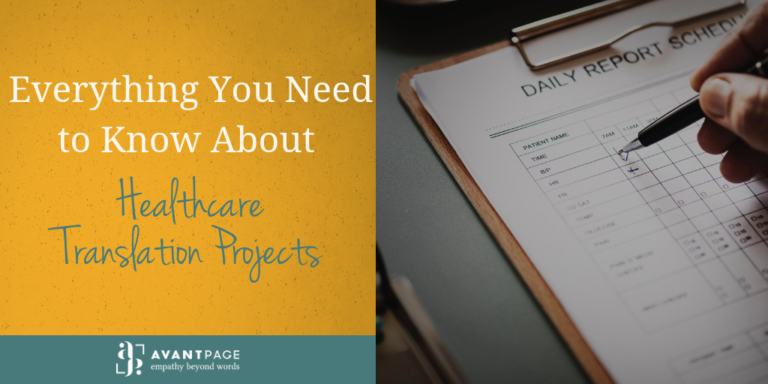
Healthcare organizations must comply with many different regulations and standards. So, it’s no wonder that there’s confusion about the kinds of documents these organizations should translate! Thankfully, you don’t need to reinvent the wheel when it comes to your healthcare translation projects. If you don’t know where to start with translating your documents, here are some of the most common healthcare translation projects we do. While each organization can determine what documents they want to translate, there are six types of vital documents that your organization must translate. These documents include: Title IV requires these documents to be translated for any Limited English Proficiency (LEP) language group that constitutes 5% of the population or 1,000 people, whichever is less of the served population. Health plans translate a variety of other documents for their member base. The most common documents health plans want to translate include: As a health plan, one of the best ways to start thinking about what documents you should translate is to ask yourself or your team: “What do our members need to know?” If your English-speaking members need the information you’re providing, your LEP members also need that information in an accessible format. Anything that contains vital information about coverage, benefits, providers, etc. should be added to your list of must-do healthcare translation projects. Hospitals, doctors offices, therapy offices, and plenty of other healthcare organizations also need to think about other documents they’ll need to translate. Some other common documents we receive translation requests for are: information you’re providing, your LEP members also need that information in an accessible format. Anything that contains vital information about coverage, benefits, providers, etc. should be added to your list of must-do healthcare translation projects.
Other Common Healthcare Translation Projects
Hospitals, doctors offices, therapy offices, and plenty of other healthcare organizations also need to think about other documents they’ll need to translate. Some other common documents we receive translation requests for are:
Medical notes, records, and reports
Medical diagnoses and documents
Medical devices and procedures
Clinical trial information
Medical history, physical health, and mental health questionnaires
This may seem like a lot of documents to consider as you’re putting together your Language Access Plan, but it all comes down to what your members or patients need to know. If the information is vital to your English-speaking members and patients, it’s also vital to your LEP members and patients. Giving your LEP members and patients documents that they can clearly understand increases patient satisfaction and decreases the risk of negative health outcomes. Fully understanding what documents must be translated for your LEP members and patients helps them and your organization.
If you’re still confused about where to start and what documents to translate, we’re happy to help! Call us today at 530-750-2040, or request a free quote. We can walk you through everything you need to know about healthcare translation projects!
Get valuable content delivered directly to your inbox. Sign up for our newsletter today!
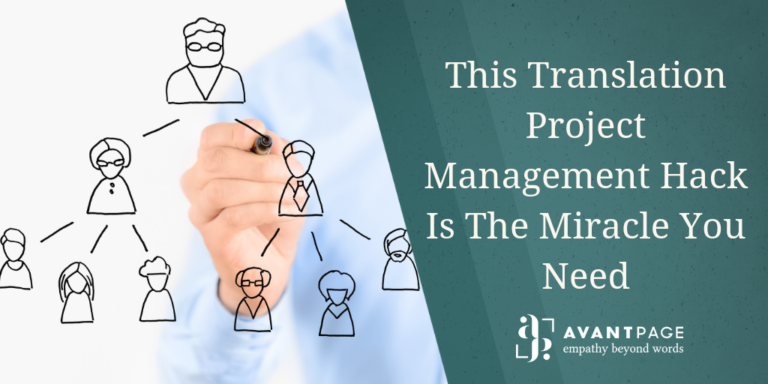
This Translation Project Management Hack Is The Miracle You Need
Solid translation project management is the key to keeping the process running as smoothly and stress-free as possible. However, many people are involved in your translation project, including those in your organization and the individuals with your Language Services Provider. All those people can result in the proverbial problem of too many cooks in the kitchen. So, how can you clearly define everyone’s responsibilities to keep your translation project management on track? We’d suggest at RACI chart. A RACI chart, also known as a responsibility assignment matrix or a linear responsibility chart, defines the various roles needed for completing task or deliverables for a project. It is a handy tool for clarifying roles and responsibilities in cross-functional and departmental projects and processes. RACI is an acronym that stands for the following: For translation project management, a RACI chart can help every person involved understand what their role is and the expectations that go along with it. Each of the words and letters in RACI refers to a person's responsibility and role in the project. Here's a further definition of each one and examples of how it might apply to your translation project management: A RACI chart can help with translation project management by clearly defining the roles of every person involved. According to a Gallup study, employees who have clear priorities at work are more likely to be engaged and achieve better results. Before you begin your next translation project, contact us to discuss your needs and we can help you with a RACI chart template. Consider all the people who may be involved and what roles they will play. Then, introduce the RACI chart at the beginning of your translation project and show each person the part they are expected to play. By clearly laying out expectations and involved at the beginning of your translation project management, you are more likely to have better results and a less stressful process. Effective translation project management is one of the many benefits of working with Avantpage. If you want to learn more about how we can work together to streamline your translation projects, give us a call at 530-750-2040, or request a free quote.

ADA Voting Rights: How to ensure compliance
Although voting is a fundamental right in the United States, people with disabilities face many issues at polling places, despite there being ADA voting rights to protect them. The Americans with Disabilities Act (ADA) sets requirements for polling places to ensure that people with disabilities can vote. These ADA voting rights cover many topics, including alternate formats of voting materials to physical space requirements. States can set their own laws addressing the mental capacity of voters. People who have developmental disabilities may find themselves challenged at their polling place. However, a person must be proven mentally incapable in a court for their voting rights to be taken away. This decision cannot be made by the polling place itself. So long as a court has not deemed the person with developmental disabilities to be incompetent, they have the right to vote, and the polling place must accommodate them. For federal elections, ADA voting rights require that voting systems must be accessible to all citizens, including those with impaired vision. Additionally, ADA voting rights demand that people with disabilities receive reasonable accommodations at other state and local elections. In the case of federal elections, those with impaired vision must receive a direct reading electronic system or another system of comparable quality. In the case of other elections, communication between election staff and people with disabilities must be as effective as the staff’s communication with people who do not have disabilities. This means that at every stage of the voting process from registration to casting the ballot, auxiliary aids must be available to those who need them. These auxiliary aids can include providing a dedicated reader or offering alternate formats of the ballot such as large text or braille. Polling places must also be physically accessible to people with disabilities that impact their mobility. People in wheelchairs must be able to physically enter the polling place and also approach a voting machine, or there must be a reasonable accommodation to allow people with limited mobility to vote. Under the Americans with Disabilities Act, people with disabilities are granted reasonable accommodation if they cannot vote alone. This can include having a family member, friend, or staff at the polling place assist them. Assistance can range from help using the voting system to an explanation of the voting process and instructions in plain language. This requirement is part of every step of the voting process as well. If a person with a disability needs assistance to register to vote, it is legally required that they receive that assistance. The ADA very clearly stands against the discrimination of people with disabilities. ADA voting rights state that any public entity with a policy or procedure that could prevent people with disabilities from voting must immediately change their policy or procedure. Any available accommodations that can be reasonably acquired for people with disabilities should be given. This includes allowing service animals into polling places, providing chairs for people who cannot stand for long periods of time, and allowing those with temperature intolerance to wait inside before voting ADA voting rights protect people with disabilities from having their fundamental right to participate in democracy revoked. There are third-parties that can help you ensure that your polling place meets all ADA requirements. If you want to learn more about providing alternative document formats at your polling place, call us today at 530-7502040 or request a free quote.

Here Are The Players Who Make Up Your Translation Team
Your translation team is more than just a translator or linguist who is working diligently to translate your content and documents. In fact, many people work together behind the scenes to ensure the quality of your translation at each step of the process. Here are some key roles a capable translation team will have. On a day-to-day basis, the project manager is whom you'll work with the most on your translation team. This person is intricately involved in all the details of your project, from understanding the content to spotting confidentiality issues to selecting the best translators and designers for the job. Your account manager gets involved when your needs go beyond an existing translation project. For example, if you want a different service that’s not in your contract, your AM will be the person who asks some questions about your needs to develop pricing. Your AM can also work in tandem with your PM to help resolve specific problems. Every project is a bit different when it comes to geography, field, and language, and finding the right linguists who fit those specifications is essential. To find the right fit for your translation team, your PM should match qualified translators with your specific project's needs and languages to ensure success. The proofer is the quality control person on your translation team. This person focuses on the last step of the translation project and ensures the quality of the translation, the layout, and any non-linguistic requirements. These people focus on details and understand how to work with style guides and specifications. Depending on the complexity of your project, your translation team may also include designers and other professionals who can help steer your project to success. For almost every project, a capable and talented translation team can make all the difference. At Avantpage our experienced translation team can help guide you through the translation process and make it fast and easy. To find out more about our services or to get a free quote, Email us at [email protected] or call us at 1-530-750-2040, extension 6.