
Blogs

Yes, You and Your Team Need HR Translation
Translation services are beneficial in nearly every industry. While some are required to translate their documents, most simply see the benefit of clear communications, regardless of regulations. Human Resources professionals can see a variety of benefits from HR translation projects. If you work for a global company, HR translation projects become even more important as you look towards building an inclusive community. If you’re interested in translating your HR documents, but not sure where to start, there are a few key documents to look at translating. First, consider translating your HR policies and procedures. If you have an employee handbook that sets out the expectations for how your team works, this would be a vital document to translating. If you need all of the employees in your organization to follow a single set of standards, or comply to a single policy, then a miscommunication of those standards/that policy could cost you more than just frustration; you may be looking at legal penalties, lost time, or increased overhead costs as a result. Company announcements also require translation. Ensuring that all of your organization understands what is going on internally can help to increase efficiency, create community, and prevent misunderstandings. Finally, translating safety and benefits information should be top-of-mind. Employees need to learn about and fully understand the relevant safety information and benefits the company offers. All team members need to know how to keep themselves safe on the job, and all team members need to understand what insurance options and other benefits are available to them. While HR translation projects are not legally mandatory, there are many different benefits that you can see from pursuing these projects. In the United States, we’re increasingly seeing a blended workforce. A mix of nationalities, cultures, and languages currently exists in our county, and having an efficient workplace means including all people that could work for your organization. Being prepared to support a multilingual workforce, with proper training and informative materials, allows your organization to expand its recruiting efforts and even consider expanding globally. Beyond this, translating these documents creates a culturally sensitive and inclusive work culture. This promotes a sense of loyalty among your employees and can increase your employee retention rates. Regardless of whether your company is global or local, there’s no doubt that HR translation projects benefit your organization as a whole. We can help you get started on your next HR translation project, and build expand your organization’s hiring opportunities. Call us at 530-750-2040 or request a free quote today.
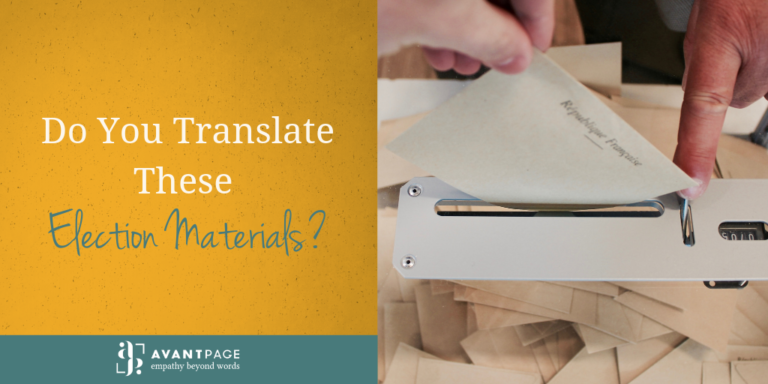
Do You Translate These Election Materials?
There are many different documents involved in holding an election. From your signage to your voter information guide, you disseminate a lot of information to the constituents in your district. While regulatory compliance requires translation of some of these documents into key threshold languages, there are some election materials that don’t frequently get translated. The materials that aren’t generally translated for elections include: There may also be parts of your candidate statements and ballot measures in the Voter Information Guide that don’t always get translated. As a county, it can be challenging to get these translations from your municipalities and candidates, even though they can be immensely helpful to your Limited English Proficient (LEP) constituents. These election materials may not be translated for a variety of reasons. Time, budget, and personnel constraints can all play a role in the effective translation of your documents. While it may seem unnecessary to expand your translations beyond regulatory demands, there are many different benefits to translating these election materials. A more informed electorate. Providing your LEP voters with all of the knowledge they need to vote in a way that aligns with their values and ideas supports an increased sense of community. Beyond that, an informed electorate supports more active participation in the democratic process. Increase LEP voter turnout. If your LEP constituents understand your election materials, they’re more likely to go to the polls on election day to cast their votes, allowing all of the United State’s diverse population to actively partake in elections. Accessibility of the democratic process. As an eligible American citizen - LEP, immigrant, or otherwise - you have the right to vote in elections. Making the process accessible is the hallmark of democracy; every vote matters, and no eligible voter is left out or faces discrimination. It’s the right thing to do. All eligible voters in a democratic society should have the opportunity to make their voice heard and feel like their vote is informed. Translating your election materials creates a more inclusive society. If you have the time and budget to spare, translating your election materials into emerging threshold languages can also benefit your LEP constituents. While your district is only regulated to translate into specific languages, staying on top of the languages used by growing language communities in your area, and translating your documents for them, has many benefits. For your organization directly, in the event that one of these languages rapidly becomes a threshold language, you’ll already be prepared to meet the new regulatory requirement. You won’t be stressed at the last minute trying to get your documents translated into the new language, and you’ll be far less likely to incur rush fees for the projects. For those in your community, these translations have all of the same benefits as translating the documents mentioned above. You’ll be actively creating a sense of community, making the democratic process more accessible, increasing LEP voter turnout, and more. If you want to translate the mentioned election materials or any other election materials, we can take care of the project from start to finish. Call us at 530-750-2040, or request a free quote today to get started on your next election translation project.

You Should Learn About Rare Languages: Hmong
There are many rare languages in the world today in various states of endangerment or preservation. At Avantpage, we work with a variety of these languages to support their speakers and continue improving available opportunities for all people. When looking at supporting rare languages, and preserving them before they become endangered, education is of the utmost importance. Sharing information about a language and, more broadly, its culture can support better language preservation and cultural acceptance. With all this in mind, every month we’ll be highlighting a rare language we work with. This month we’re focusing on the Hmong language. The Hmong language, or Mong, is a Hmong-Mien language, a group that consists mostly of minority languages spoken in Southern China and Southeast Asia. Apart from Hmong and Mien, this language family includes Hmu, Qo Xiong, Bunu, Pa-heng, She, Mun, and Biao Min. Hmong is used primarily in China, Vietnam, Laos, Thailand, the United States, and French Guiana. While the exact number of speakers worldwide is unknown, it’s estimated that 2 to 3 million people use the language. The standard dialect of the language is Western Hmong, a group of dialects spoken in southwestern China, Northern Vietnam, Northern Thailand, and Laos. The two major varieties that comprise this group are Hmong Daw and Hmong Njua, named according to the traditional colors worn by women of the different groups - White for Hmong Daw and Green or Blue for Hmong Njua. Outside the above-mentioned areas, the language is spoken by relatively substantial groups in Burma, France, and the United States; the most predominant population of speakers is found in China. Today, most of the over 260,000 people of Hmong descent residing in the United States speak the dialects White and Green Hmong, White being the predominant version with 60% of speakers using it. The key differences between the dialects are in the pronunciation/phonology and vocabulary. Interestingly, the Hmong language has no official status in the countries in which it is spoken. As a matter of fact, it consists of a number of dialects, many of which are unintelligible to speakers of other Hmong varieties. Linguistically speaking, each dialect is considered to be a separate language, since the definition of a dialect assumes it is a mutually intelligible language variety. There are numerous writing systems used for writing the language, with Phahawh considered the most linguistically aware of them. It was developed mid 20th century by Shong Lue Yang, a spiritual leader honored among Hmong people as the Niam Ntawv (Mother of Writing). The most common Hmong orthography became, however, the Romanized Popular Alphabet (RPA), devised by missionaries in the 1950s. While Hmong is a rare language, we work with it on a semi-regular basis in the translation work we do for varying clients around the United States. If your population includes Hmong speakers, we’d be happy to discuss with you how to reach them through translation services. Call us at 530-750-2040 or request a free quote today to get started.
Preparing for Translation in 9 Easy Steps!
One of the best ways to save time, money, and to improve the quality of your translation project is preparation. Preparing for translation can support your longterm language access goals, and help to keep all of your translation projects organized and manageable. When your patients understand the material, the risk of adverse medical events decreases, and patient satisfaction increases. Using words and images that are easy to understand, and simple, inviting presentations encourages your patients and their families to understand the document better. Preparing for translation by following these guidelines will help to ensure your translated documents are accessible to all of your patients and members. Have a logical sequence of ideas. If the ideas have a logical arrangement, such as chronological order or cause-effect, the text will be easier to understand. Preparing for translation with graphical elements and short-form text. Sentences and paragraphs don't communicate your whole message. Using images, lists, charts, and diagrams (A.K.A. short-form text) can help your patients understand your translated medical document better. Here are some examples you can use: Write in an active voice. The passive voice is less concise and can be confusing. A simple way to identify the passive voice is to look for the verb or action of a sentence. When the subject of a sentence directly performs an action, the sentence is in the active voice. Preparing for translation with short sentences. Long sentences lead to misunderstandings and confusion. To avoid long sentences, use short, plain words and phrases. Use common, everyday language. Use simple phrases and words to explain your ideas, which will be easier to translate. Try to write as conversationally as possible. For example: Preparing for translation by using pronouns. Pronouns can replace proper nouns in a sentence. They make your sentences less repetitive while keeping the meaning intact. Avoid Idiomatic Language Often, documents that contain idioms and expressions that are natural to a native speaker don't translate well. The phrase "don't throw out the baby with the bathwater!" has cultural and historical meanings that may not be understood in a different language or culture. Avoid phrases like these and use clear language whenever possible. Preparing for translation by maintaining simple formatting. Simple formatting on the original document means less formatting in the translation—resulting in lower costs. Some basic formatting guidelines include: Know the reading level of your audience. Your documents need to be written at a reading level that's appropriate for your audience. It's easier to translate your documents into that reading level if the original is also written that way. Keep in mind that most of the content for your patients or members usually needs to be written at a lower reading level. However, document purpose and function can influence the desired reading level. Preparing for translation doesn't have to be challenging. If you walk through your documents with these elements in mind, you can help to ensure the success of your medical translation project. If you'd like to get started on your next translation project, call us at 530-750-2040, or request a free quote today.
The Best Kept Website Localization Secrets
Reaching a new target audience with your website content is dependent on a variety of factors. The language, culture, color standards, use of graphics, and so many other pieces of your content play into whether you’ll successfully target your organization’s desired audience. One way to increase the success rate of reaching out to a new audience is to pursue website localization. Website localization is the process of adapting your web content to a specific locale or market. It involves the adaptation of graphics, content (including idioms, jokes, etc.), design and layout, measurements, dates, and more. The goal of website localization is to make your online presence feel as though it were originally written and created in the target language/culture. While undertaking a new website localization project can seem overwhelming, there are a few key best practices that can help to reduce the stress surrounding them. Identify your target region, culture, and language. Going into a localization project with all of the information you need about the target audience your organization is trying to reach will help to ensure you don’t waste time and money on your localization project. Be sure you have an understanding of the dialect(s) used in the area, the predominant culture in the area, and the target market for your product or service. Gather your brand assets. Before starting a website localization project, gather your logo, stock photos, downloads, and any other content that you’ll want to be on the localized version of your website. If you have the native, editable files (from InDesign, Photoshop, Illustrator, etc.), those are of the most benefit to your localization team, who will take great care to ensure the colors, fonts, and messaging of your assets will reach your target audience. Define your project scope. If your website has a wide variety of pages or a lot of content, it’s of benefit to your organization and your project to determine which aspects of your website will best reach your target audience. If you don’t know where to start with identifying the content that would be best for your localization project, you can work with your Language Service Provider to help make that determination. Make use of linguistic assets. Translation style guides and glossaries can benefit your website localization project positively, increasing the consistency of your translated terms across the website. Additionally, Linguistic Assets help to streamline the process by letting each of the translators working on your project know beforehand what should and shouldn’t be translated, and if there are official translations for particular brand language. Be sure to work with a provider who uses Translation Memory software as well, so these assets are saved and used across your projects. Additionally, Translation Memory ensures consistency across documents, streamlines the translation process, and can save you money on repeated content. Hire an expert. You know your industry, but localization experts can help you to reach that new market more effectively than localizing in-house. Your combined expertise will allow the project to be completed in a more timely and effective manner. We can help you get started on your next localization project. Call us at 530-750-2040, or request a free quote today.

What You Need to Know About LEP Populations
The work we do is centered around creating opportunities for those that do not otherwise have them. We work so the immigrants, multilingual, and Limited English Proficient (LEP) populations in our society can fully comprehend the information they receive from the organizations they acquire products and services from. An LEP individual is officially defined as an individual “who [does] not speak English as their primary language, and who [has] a limited ability to read, speak, write or understand English…” In many cases, LEP individuals are entitled to language assistance in their interactions with particular kinds of services, benefits, and experiences. There are a wide variety of laws that govern communication to LEP populations, regardless of the organization doing the communication. Title VI prohibits discrimination on the basis of national origin and has been expanded to include discrimination on the basis of English proficiency. Under Title VI, Limited English Proficient individuals must be provided with meaningful access to programs and all their services. Executive Order 13166, which affects federal agencies, says that “people who are LEP should have meaningful access to federally conducted and federally funded programs and activities.” This Executive Order demands that Federal agencies examine the services they provide, identify any contact points with LEP populations in those services, and then develop/implement a system for LEP people to have substantial access to them. Limited English Proficient also includes those that have communication disabilities – visual, hearing, or speech impairments. For these people, the ADA and Section 504 require that services and programs in integrated settings must meet the needs of those with communication disabilities without discrimination on the basis of those disabilities. All of the laws regarding communication with LEP individuals mention “meaningful access” without directly describing what that looks like. Meaningful access is based on a four-factor analysis from the U.S. Department of Justice: In its most basic form, providing meaningful access to LEP populations is simply making your benefits/products/services as accessible to Limited English Proficient individuals as they are to native English speakers. The most successful way of achieving this goal is to work with a trusted Language Service Provider who can translate, format, and localize your documents. We can help you reach more LEP individuals with your services through our high-quality, accurate translation services. To learn more, or to get started on your next translation project, call us at 530-750-2040, or request a free quote today.

Why You Should Care About Endangered Languages
There are approximately 7,000 languages in the world. While half of the world speaks the largest 16 languages, it’s estimated that about 40% of those 7,000 are now considered endangered. Endangered languages fall on a spectrum of five categories which are used to define how at risk the language is: According to the Endangered Languages Project, there are many different factors that impact the vitality of a language. Languages enter into endangered status when they are passed on less to further generations. If your mother tongue is not passed down, and older generations are the only speakers, the language begins to pass away as the older generations do. Some of these languages, particularly Indigenous Languages, are isolated from the rest of the world. While there may be hundreds of speakers in these insular communities - the lack of outside contact with the language creates the situation in which the language is endangered. When we lose a language, we also lose part of the culture attached to it. Languages allow us to see the world from another perspective, and communicate in a new or different way. Languages are a transmission vehicle for culture, and as languages die, the cultures they represent also begin to die. Preserving languages allow us as a collective to preserve the cultures they represent. More and more, the issue of endangered languages is being considered as a critical one. Many new projects have emerged which promote the preservation of these languages, and thus the cultures they represent. For more information on preserving endangered languages, the following sites provide a variety of resources: Linguistic Society of America
UNESCO Atlas of the World’s Languages in Danger
Endangered Alphabets
Endangered Languages Project If you’d like to start a translation project in an endangered language or any other language, give us a call at 530-750-2040, or request a free quote today.

Everything You Need to Know About Language Technologies
Language technologies continue to advance as the translation industry becomes increasingly popular and more organizations look towards translating their documents. While there are many different language technologies, there are a few common ones used by Language Service Providers (LSPs), and a few that are commonly used for other commercial purposes. Machine translation (MT) is a translation technology that doesn’t involve the use of human translators. All translation work done is completed by machines. This can be grouped into four main categories: While MT has come a long way, it isn’t ideal for translating legal documents, or documents that you’re using to reach a particular target audience. Frequently, these language technologies will produce translated documents with errors that are easily spotted by your target audience. This can not only create a poor social image of your organization but can also decrease your target audience’s likelihood of engaging with your product or service. MT can be used by LSPs but is primarily only used to check the accuracy of a translated document in the quality analysis stages. At Avantpage, our QA is done by human linguists to ensure that your document will appropriately reach your target audience with no language errors. A CAT tool is a “Computer Aided Translation” tool. These tools are designed to help the translation process run more efficiently. A CAT tool essentially functions to create a Translation Memory (TM) for your organization. A TM is a database of past translations, which are used to increase translation efficiency. When your translation project is completed, the language from the source document is stored with its translation in this database. Over time, your database grows, and any new translation projects you start are run against the database to find matches. Using a CAT tool to create a TM allows for increased efficiency in translating your documents, as well as increased consistency across your translated documents. If you have words, phrases, or sentences that are repeated across your documents - they’ll always be translated in the same manner. The consistency of your translated documents can also be increased through the use of linguistic assets like style guides and glossaries. These inform your translators of how certain words and phrases should be translated before they begin working on your documents. At Avantpage, we use a CAT tool to increase the efficiency of your translations and help keep your projects in-budget. If you’d like to get started on your next translation project, or want more information on how language technologies benefit your translation projects, call us at 530-750-2040, or request a free quote today.
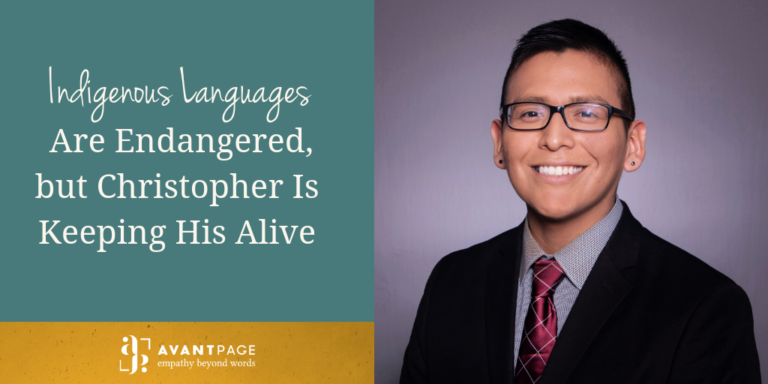
Indigenous Languages Are Endangered, but Christopher Is Keeping His Alive
The United Nations declared 2019 as the International Year of Indigenous Languages. In this declaration, the UN is hoping to raise awareness of endangered Indigenous Languages, the consequences of these languages disappearing, and the links between language, peace, and development. Indigenous languages are languages native to a region and spoken by Indigenous people who have been settled in the area for many generations. Many Indigenous Languages are at risk of disappearing because, as generations go by, speakers begin to lose proficiency in their traditional/native languages. That’s why, now as much as ever before, it’s important to continue to share the stories of those who keep Indigenous Languages alive - like our bookkeeper Christopher Rosales. Christopher is a full-blooded Navajo Native American. Growing up, he was taught the Navajo language and has put in considerable effort to keep his language skills. “Storytelling is its own subsection of Native American studies...less is written down and more is shared orally. Language is really big for Native Americans because of this.” Christopher grew up in Northern Arizona on the Navajo Reservation and moved to California to pursue a college degree. When he first made the move, finding a new community was a significant challenge for him. “It took 6 years to find another full-blooded Native American, which conflicted with my need for community. You can go to Pow Wows here and there, but even then it’s 1-2 days out of the month where you’re surrounded by your people. It’s hard to find a permanent community unless you’re on the Reservation. I didn’t fit into other cultural circles.” Christopher made a concerted effort to maintain his cultural identity otherwise. He was driven to make the presence of Native American known, and advocate for those who didn’t have the opportunities he did. “I sponsored a Sac State student who was also Native American. A big part of being able to help them was understanding where they came from. We’d have a lot of conversations about what’s different here, and how I succeeded in being thrown into this mix. A big part of [my cultural advocacy] is wanting to help others later.” Christopher’s advocacy has taken shape as speaking engagements, sponsorship, and language practice. “You can’t hold a class on how to speak. I use [language] as a key point in resisting the urge to let [my] culture die. We’ve been programmed and predisposed to throw away the culture, and any retainment of that culture is done out of resistance.” Christopher practices the Navajo language daily, even just with himself - translating daily conversations and words into his native language in his head. “Retain as much of your language as you can, but don’t feel pressure to remember anything. Big or small, take whatever steps you can to anchor your culture. Learn the language, go to Pow Wows, stuff like that...Retain as much as you can, and at least attempt to give back to the community that needs help.”
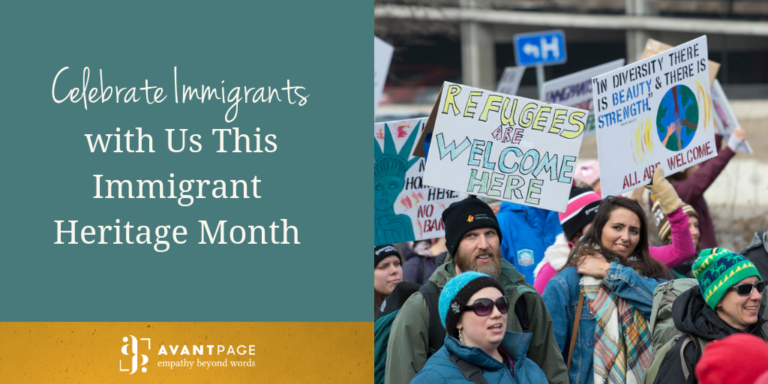
Celebrate Immigrants with Us This Immigrant Heritage Month
Since 2014, the organization I Am An Immigrant has encouraged the celebration of immigrants and culture sharing through the celebration of Immigrant Heritage Month. Every June, Immigrant Heritage Month reminds us to celebrate immigrants and their contributions to America and American culture. Immigrant Heritage Month encourages all Americans to celebrate the contributions immigrants make to our society. It creates new avenues for individuals, communities, organizations, and leaders to support the immigrants around them. In this month, we come together to celebrate immigrants for who they are and work to increase our ability to support them. At Avantpage, our mission is simple: to empower immigrants to achieve their American dream through trusted language translation. We work tirelessly to provide opportunity to all people by ensuring they can understand the new world they’ve entered into. This mission is deeply seated in our organization for many reasons. At our core, we are an immigrant-founded language service provider. Luis Miguel, our CEO, came to the United States as a teen in 1973 for a summer camp and set his mind to emigrate and chase his own American dream. When he started as a college freshman in January 1978, he was faced with the very real need for language support and access to connect with the people around him. Many of our employees have seen first-hand how language services and support can improve the lives of immigrants because many of our employees are immigrants. Regardless of where they’ve come from, what country they’ve chosen to move to, the common thread among their stories is decreased access or accessibility in language. Language is one of the many ways we connect with other people; in fact, it’s likely the most common way we connect with others. Immigrants who have imperfect control of the language in their new country can face discrimination, isolation, and other adaptation challenges. At the same time, immigrants have done incredible things to support the countries they are now a part of. We celebrate the immigrants that work with us to create greater language access, the immigrants that had to fight to escape persecution and bring their culture to their new home, and every immigrant in between. To celebrate immigrants is to celebrate the contributions they make, both tangible and intangible, to their new country. Without immigrants in the United States, our melting pot culture would not exist, nor would some of the most incredible achievements we’ve seen in our history. If you support immigrants, and you value creating opportunity for all in the way that we do as an organization, action is necessary. No action is too small, especially in our current political climate, to show your direct support to the immigrants that mean so much to our nation. Reach out to your elected officials and tell them how important it is that the United States remain an open and welcoming place to all. Thank those officials in your local area that are supporting and standing up for immigrants. Offer monetary donations to organizations that are directly taking action to ensure immigrants are safe and cared for before, during, and after they cross our border. If nothing else, start talking. Host a supper club in your community where all are welcome. Write about the positive impact immigration has had on your community; change the narrative. Living under a “zero-tolerance” policy should mean zero-tolerance for hate, discrimination, and prejudice - not zero-tolerance for the immigrants who need our support. Join us this month, and every month, in celebrating the immigrants around us. Do what you can, no matter how small it seems, to support the United States as a land of the free, where anyone can chase their American dream.
Your County Needs Multilingual Ballots, This Is Why
As our population continues to diversify, it becomes even more important to ensure that all people in the United States have equal access to participating in the democratic process. The next election continues to draw near, and planning your translation projects to create multilingual ballots should be top-of-mind. Offering these ballots provides your Limited English Proficient (LEP) constituents with many benefits including, but not limited to, access to the democratic process. To maintain your regulatory compliance, it is necessary that you provide minority language ballots in addition to English language ballots. The language from the Voting Rights Act states that: “all election information that is available in English must also be available in the minority language so that all citizens will have an effective opportunity to register, learn the details of the elections, and cast a free and effective ballot.” The Voting Rights Act is in place to ensure that all LEP constituents in your area can effectively partake in the democratic process. While it only requires translation of your documents into specific threshold languages, many counties choose to expand the number of languages they translate their elections documents into. If you have growing language communities in your county, you may want to translate your documents into those languages as well to increase voting accessibility and voter turnout. Beyond the regulations put in place by the Voting Rights Act, there are many other benefits to multilingual ballots and other translated elections documents. If you’ve been looking for a way to increase voter turnout among your LEP populations, translating the signage at your polling center, voter information guides, and other polling information can support that goal. Additionally, employing bilingual workers at your polling place can help your LEP constituents to feel more comfortable asking questions and participating in the democratic process. Language in an of itself is a tie to community and culture. Translating your elections documents allows LEP constituents in your area to feel more connected to the government that serves them, increasing participation rates in the election. Above all else, translating your election materials creates opportunity. The hallmark of a democratic process is that it allows all to participate in an open and free election, regardless of their conditions and as long as they are above the legal voting age. Providing multilingual ballots and other translated election materials supports this opportunity and can create a feeling of acceptance in your district and across the country. We can help you get started on your next election translation project. Give us a call at 530-750-2040, or request a free quote today.

Get the Most out of Your Translation Budget with These 10 Tips
There are many different resources you need to keep track of when it comes to your translation projects. One of the vital aspect to track is your translation budget. If you want all of the benefits of your translation projects at the most affordable rates possible, these 10 tips for lowering your language access costs will benefit your healthcare organization. Save time and effort by submitting your changes electronically and avoiding handwritten notes or scans. These requests are difficult to implement, which adds time and expense to the project, not to mention the possibility of introducing human error into the process. Instead, make the changes within the files, and you’ll be more likely to stay within your translation budget. Finally, one absolute way to increase the cost of your medical translation is to ask someone who is not qualified to do it in the first place. A bilingual employee is not a professional translator and may make mistakes regarding the accuracy and consistency of the document. By hiring a professional language service provider like Avantpage your staff stays focused on their assigned tasks while we accurately and consistently translate your message within your translation budget. If you’d like to get started on your healthcare translation projects, call us at 530-750-2040 or request a free quote.