
Blogs
Client Spotlight: Marge Mink's Dedication to Language Access
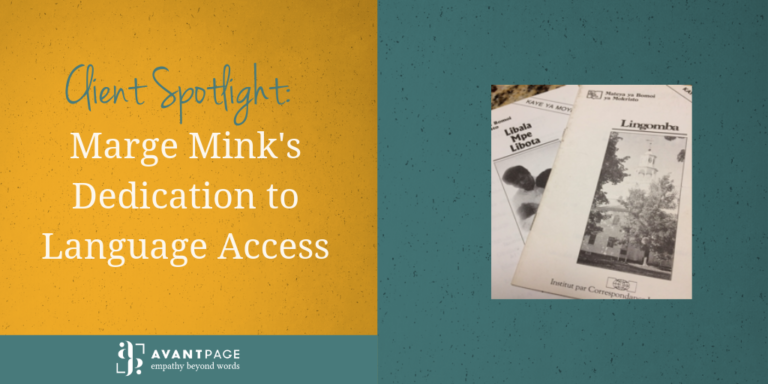
One of the best parts of my job as Head of Client Services at Avantpage is the opportunity to sit down, in real life, with our clients. In a world full of email, instant messaging, and CRMs, to sit around a table with a handful of Avantpage partners is a rare treat. Even rarer is the opportunity to step away from the conference room, sit down to lunch, and talk about things other than translation workflows, style guide updates, and budget management. One such occasion came back in August of 2018. Our Account Manager Eduardo Diaz and I were the lucky recipients of an invitation to lunch at a local Mexican restaurant by WA Department of Licensing (DOL) Forms and Records Analyst, Marge Mink. (And just to be clear from the start: as an LSP with many government partners, it’s important to note that we always pay our own bills!) Marge is our go-to expert at DOL for everything layout and design, and so, over an early lunch of flautas and tamales, we asked how she got into this field. She described an initial position in the early 80s with Valley Press, a printing company in Puyallup, WA. She walked us through a career path that led to the beginning of her tenure at DOL in the late-1980s. It’s interesting to imagine how much the field of DTP and accessibility (Marge’s areas of expertise) has changed over the decades, but not as interesting as the story she told us next, or her dedication to language access. While Marge was working with the print shop Valley Press, the owners began producing bible study materials for an Assembly of God missionary program they were involved in. Missionaries would send text via Kaypro computers, which would, in turn, be produced into a set of printed booklets. Once the printing work was complete, one French-speaking and one English-speaking missionary (the latter from Marge’s hometown of Erie, PA) set off with a set of 16 booklets in Lingala, the language spoken by the local tribe with whom they would be working. Marge was delighted to take part in this opportunity to provide greater language access to the tribe and the results were incredible - not just due to the content of the brochures themselves, but to the fact that this was the first time the tribe had seen or received a printed document in their language. So fascinated was the local population with the material, the translations for which came partly from previously-printed ICI (Institut par Correpsondence International) booklets, that they asked to see a photograph of the person had produced such a treasure. So began the connection between the tribe’s Chief and Marge, who was working away back in rainy Puyallup. Marge described how moved she was by the impact her work was having on a community so far from her own, and her ensuing motivation to create a dictionary of Lingala vocabulary as a gift for the village: “When I found out they had never had a printed word previously, I asked my boss if we could run the booklets through the computer and search for all unlike words to create a dictionary. And we did!” Lingala is a Bantu language spoken by over 70 million people across the DRC, Republic of Congo, Angola, and the Central African Republic. Literacy rates are low and it is considered a primarily spoken language. Its various dialects borrow English, French, Spanish, and Portuguese words from colonial rulers of the past. Unfortunately, Marge’s copy of the dictionary no longer exists, but the knowledge of what this customized printed document meant to the tribe and their language access is still very real. In her home in Olympia hangs a painting, created by the Chief to thank her for the care she took in producing this gift for his community. Cobbled together from white paint and natural colorings, the painting shows the Chief himself, sitting in the shade of his hut. A quick online search reveals a few dictionaries for sale, as well as various online sites dedicated to translating Lingala into English and French. Bamonimambo (The Witnesses), a book by Norbert X Mbu-Mputu, Deo Katya Kasereka, and AlainFranque Monzelo, dates the first official Lingala dictionary to 2001 - almost 20 years after Marge’s creation. I hope that the dictionary still exists somewhere and that it is as treasured and preserved in the Chief’s village as his painting is in Marge’s home. Whether it does or not, Eduardo and I were delighted to step out of our work shoes for a few minutes and to hear such an inspiring and personal story. We work hard to promote language access at Avantpage, and the thought that we help create cultural bridges is why we do what we do. It’s a wonderful thing when we see our clients striving for the same goal, and in such fascinating and unexpected ways.
The Many Roles of Your Language Translator
The role of a translator may seem straightforward: the translator converts text from the source language to the target language. But while this is technically accurate, the role of a skilled translator is much more complex and goes far beyond this simple definition. The translator plays a direct role in communicating with your target audience. The main role of the translator is to ensure that your original message comes across to the reader exactly as it was intended, without any distortion. When a translator receives a document, they go through a series of steps to create an accurate depiction of what was said in the original message. This means not only looking at the words of that message, but also faithfully delivering the context to the target person(s) in a manner which they can understand. Another role of the translator is to understand the target audience’s culture and to ensure that this understanding is portrayed in the written translation. This allows your message to come across more effectively and more accurately. Wherever possible, working with a translation team that shares the culture of your audience will create more trust, higher levels of accuracy, and an unspoken relationship. The translator you work with should be a subject matter expert in what they are translating. When you work with a Language Service Provider (LSP) like Avantpage, your translators have proven experience in the subject that they are translating. This creates a more nuanced end product and helps to ensure that industry terminology is translated in an accurate manner. Finally, the translator plays a role in helping to increase the rate of growth of your organization. Translating your documents has benefits far beyond regulatory compliance. Pursuing translation projects can increase the social image and reputation of your organization, which in turn leads to customer/member loyalty and helps you to attract new business. The translator supports your organization in many different ways. Working with an LSP like Avantpage means that you can rest assured that translators fit the above criteria. But that’s not all: an LSP also provides a multi-step editing process, quality control, account management, and so much more. We can help you get started on your next translation project; give us a call 530-750-2040 or request a free quote.

The Hidden Benefits of Health Plan Translation
Health plans have a lot to keep in mind when starting new translation projects. While the process of translating your documents keeps you in regulatory compliance, there are other benefits to health plan translation projects as well. The regulations that dictate what a health plan can translate come from a variety of different sources including the ACA, CMS, and Title VI. At the least, you need to translate the following documents to remain in regulatory compliance: The languages which you translate these documents into are the threshold languages in your area. These regulations all help to increase language access to your health plan services. Outside of maintaining regulatory compliance, there are many benefits to health plan translation projects. One benefit of your translation projects is increased understanding from your member base. This can create a positive brand image and social discussion surrounding your health plan, potentially driving more business. Additionally, health plan translation projects increase the overall satisfaction of your Limited English Proficient (LEP) members. This increase in satisfaction creates a more loyal member base which, in turn, creates more business and generates more revenue for your health plan. Above all else, providing translated health plan documents allows for your members to better understand their healthcare coverage, and have increased access to healthcare services in general. We can help you get started on your next health plan translation project. If you have questions about health plan translation, give us a call at 530-750-2040. If you’re ready to start your next translation project, request a free quote today.

Want Higher Student Success Rates? Translation Can Help!
As an educator or an education professional, you know how vital it is to engage students and parents in your school and district. Meeting the needs of each individual student when you have tens, hundreds, or even thousands in your care can be particularly challenging, but taking care to do so can increase your overall student success and graduation rates. When it comes to meeting the needs of your Limited English Proficient (LEP) students, there are many great reasons to employ translation services in your school or district. While regulations dictate what you need to translate in your education institution, there are many benefits to translating your documents beyond regulatory compliance. LEP students face a particular set of challenges. Learning how the English language is structured, how to use idioms, and how to verbally engage with other students are just a few examples of the challenges that LEP students need to overcome. LEP students also face social challenges when they enter school. They may depend on body language, have limited school experiences, or remain silent in class settings. Providing translated documents at the appropriate reading level can help these students to feel more confident in their English abilities, which in turn supports higher levels of student success. Beyond that, these translations can support a more welcoming environment in school, supporting these students’ personal growth as well. Parent engagement is simply when teachers and parents share a responsibility to help their children learn and meet their educational goals. This kind of engagement happens at school meetings and events, with parental volunteering, and with documents sent home to communicate important education-related information. It is particularly important to establish two-way communication from home to school and back when looking at increasing LEP student success. There are many ways to establish this communication and to ensure your staff can support it: Parent engagement, in all cases - not just with LEP students, is the most important predictor of student success. If you successfully engage the parents of your LEP students, these students will have more support at home and be more inclined to finish their assignments. If you want to start seeing higher levels of student success and graduation, no matter the grade level of your students, translation services can help. Engaging both the LEP students and parents in your school or district helps promote an inclusive atmosphere where LEP students can thrive. We can help you get started on your education translation projects; give us a call at 530-750-2040, or request a free quote today.
Lost in Translation? Let Our FAQ Be the Map
We know the language service industry can be complicated. There’s a wide variety of services offered, terms to learn, and people involved. We want you to go into your next language project fully informed and with a firm grasp on what the process of document translation is. A quick review of our translation FAQ will provide you with key information that you need to confidently begin your next translation project. What language services do you offer?
At Avantpage, we specialize in translation, localization, and formatting of print and digital media. We also offer a variety of additional services, such as ADA document remediation, transcription, and alternative formatting. What languages do you translate?
We offer translation services in over 150 languages, both from English and into English. Our list of available languages grows and changes. If you don’t see the language you’re looking for, let us know. We’re constantly recruiting new linguists to better serve our clients. How long will my translation project take?
The variables that go into determining how long a translation or localization project can take include word count, complexity, formatting requirements, review processes, and other factors. Each effort is unique, and we at Avantpage tailor our efforts to match your requirements on every job. At the time your project is assessed for a quote, you'll also be given an expected due date. What industries do you specialize in?
We specialize in the healthcare, government, elections, and education fields. If you’re outside of these industries, we’re still available to complete your translation projects. Our linguists have varying specializations, and we can find the right person for your translation project. What file formats do you translate?
While we can translate any document format, the easiest file formats for us to work with are those that are directly editable. If you can click in your document and add/change text, that’s an editable file format. Do you employ machine translation?
We never use machine translation at Avantpage. All of your translation projects will be translated by a qualified and certified human linguist to ensure accuracy and quality. What translation technologies do you use?
We encourage the use of, and can help create, style guides and glossaries for all translation projects. Additionally, we use Translation Memory software to build a database of your previous translations; this helps to ensure consistency across your documents. Even those phrases identified by your TM, though, are reviewed in context by human eyes to ensure correct usage and style. Who will translate my document?
Our linguists are primarily US-based, though we source outside of the US for qualified linguists as well. All PHI translation is handled strictly by our US-based linguists to ensure confidentiality and security, and allow Avantpage to closely manage the network security supporting each PHI project. How do you qualify your linguists?
Our linguists have to meet a set of qualification standards before we choose to move forward with the testing process. If they meet these qualifications, we administer a language translation test based on the ISO 17100 standards. After receiving and reviewing their efforts, if accepted, our linguists are trained on our internal procedures and work closely with our project management team to ensure success. How do you find new linguists to work with?
We have a dedicated team working on recruitment to ensure we have enough linguists to meet your translation needs. Using our global network of existing linguists, membership rolls of professional organizations, direct referrals, and other sources, Avantpage is constantly expanding our team of qualified linguists. If you’re interested in joining our team as a linguist, let us know here. How do you handle confidential information?
Data safety is one of our top priorities. If your document contains PHI or PII, we only have our US-based team work on the translation. All of our in-house employees and linguists go through the process of HIPAA training and certification. Additionally, we employ multiple methods of encryption, both in our server system and in our online cloud system. Do you have a question we didn’t answer here? Reach out to us at 530-750-2040 and we’ll be happy to connect you with a team member to answer your questions. If you’re ready to start your next translation project, request a free quote today.

Election Translation? It's Easy If You Plan for It!
As an elections professional, you have a wide variety of regulations you need to keep in mind as you look towards translating your documents for the next election. Regardless of your goals surrounding language access and voter turnout, understanding what documents are vital for election translation can help to ensure those goals are met. While each county has different threshold languages and may require different language services in addition to translation, having these documents standardized can promote the success of your language goals. Election translation is individualized by county, and dependent on what your threshold languages are. The Voting Rights Act states that, for all of your threshold languages, you need to translate the following documents: The direct language from the Voting Rights Act says, “The requirements of the law are straightforward: all election information that is available in English must also be available in the minority language so that all citizens will have an effective opportunity to register, learn the details of the elections, and cast a free and effective ballot.” With this in mind, determining your threshold languages is your highly important next step. The Secretary of State’s office will provide you with a list, but if you’re interested in how these are decided, these are the qualifying factors that make a language a threshold language: While translating for your threshold languages is legally mandated, many counties choose to expand the number of languages they translate their documents into even further. If there’s a growing language community in your area, it may be worth translating your documents into that language to promote access and increase voter turnout. Additionally, talking to the language communities in your district can help you to understand the efficacy of your translations, and whether they’re providing access in the way you would like them to. If you’re starting a new election translation project, or want to ensure that you’re prepared before the next election, we can help. From determining your threshold languages to which documents you need to translate, we’ve managed a wide variety of election translation projects for over 20 years. Call us at 530-750-2040 or request a free quote today, and start a partnership with a Language Service Provider you can trust.

What Do You Know About Your Healthcare Translators?
As you look towards hiring a Language Service Provider (LSP), one key question you need to ask is who will complete your translations, and what their qualifications are. This is of particular importance in healthcare organizations because you need to be sure that your healthcare translators are HIPAA certified and understand how to handle Protected Health Information (PHI). While each LSP will have a different process for testing and qualifying their translators, our process will give you insight into what the qualification of healthcare translators looks like. At Avantpage, we hold high standards for all of our translators, healthcare translators included. The minimum qualification standards of our healthcare translators are as follows: Beyond these minimum qualifications, we maintain a list of core verifiable credentials which informs our translator recruitment process. Those credentials for healthcare translators include: While all of these qualifications and verifiable credentials provide us with excellent candidates for healthcare translators, we want to be absolutely sure they will provide accurate and high-quality translations for your organization. With this in mind, we put all of our translators, regardless of their industry specialization, through competency tests built on the ISO 17100 standards: Our healthcare translators must meet our qualifications and pass our competency test to be offered the opportunity to work with us at Avantpage. Many of the regulations governing the translation process indicate that you need to use qualified healthcare translators rather than merely competent linguists. This is also of particular importance if you provide interpretation in your organization, which is also highly regulated in healthcare organizations. While bilingual employees and family members can serve as interpreters in cases of significant emergency, or when getting a qualified interpreter to the scene isn’t an option, you cannot use them as interpreters or translators in non-emergent situations. For the typical interactions that occur in healthcare organizations, like patient visits and member communications, you will need to hire qualified translators and interpreters under the regulations of the Affordable Care Act. Beyond this, it’s simply best practice to hire qualified translators and interpreters, or engage an LSP, to work with your healthcare organization. An LSP will be able to provide you with culturally and dialectically correct translations and interpretations. Particularly in healthcare interpreting, you want to ensure your interpreter has the same cultural background and gender as the patient, client, or member if possible. Having certified, qualified healthcare translators can help to improve the accuracy, consistency, and overall quality of your translated documents. If you’re interested in starting a new healthcare translation project with our highly qualified translators, give us a call at 530-750-2040, or request a free quote today.

The 5 Secrets to Improving LEP Voter Turnout
Voter turnout is increasingly becoming top of mind as the 2020 election cycle begins. In the 2018 midterm elections, about 49% of the 235 million eligible voters in the United States cast their ballots. Many of the exceedingly close midterm races were won or lost by less than the number of Limited English Proficient (LEP) voters in the race’s district. LEP voters can make or break an election, and supporting LEP voter turnout can help to improve participation in your district’s elections. There are a number of ways to support LEP voter turnout, and therefore your district’s voter turnout. Increasing LEP voter turnout goes hand-in-hand with your language access goals and increasing voter turnout as a whole. If you want to improve LEP voter turnout in your district, we can help. Give us a call at 530-750-2040 or request a free quote today, we can get you prepared for the 2020 election.
Unsure About Your Threshold Languages? This Quick Guide Can Help!
If you’re in a regulated industry, determining which languages you need to translate your documents into can be a challenge. With so many different Federal, State, and sometimes even Local regulations your organization needs to maintain compliance with, it’s easy to get a little confused. Each industry has its own requirements for threshold languages, otherwise known as a language that you need to translate your documents into. These threshold languages will vary from county to county and state to state, but the rules remain the same in each industry for identifying what threshold languages your documents need to be translated into. Healthcare regulations surrounding threshold languages from the Department of Health and Human Services (HHS) are related to Title VI, which prevents discrimination based on sex, place of origin, race, ethnicity, and other factors. HHS has four factors that determine which languages you need to translate into: While the HHS guidelines are loose, they give you an idea of where to concentrate your translations. The Affordable Care Act defines the requirements for a threshold language further. If 10% or more of the population living in the country is literate and speaks the same non-English language, you must translate your documents into that language. These translations must include a translation of your Summary of Benefits and Coverage (SBC) and Uniform Glossary if you have them. Election regulations surrounding threshold languages are very direct. Your county needs to translate documents for minority language groups that: If you have a minority language group that meets the criteria for a threshold language, the U.S. Election Assistance Commission states that you need to translate the following documents: Many counties include languages that are nearing the federal Commission’s mandates in an effort to provide a more inclusive voter experience or increase voter turnout among minority voters. The U.S. Department of Education has somewhat flexible guidelines for what documents need to be translated, and what languages those documents need to be translated into. The Department of Education indicates that, after a student is enrolled in a public school, the school or district must have a way of determining what language is used at home. Generally, this is done through a home language survey sent to the student’s residence. There are additional requirements for how an English Learning program needs to be staffed and run, which need to be considered as you move forward with your Language Access Plan (LAP). Educators are held to the standards of Title VI, just as healthcare providers are. So be sure to use the following four criteria to prepare your LAP and determine what you need to translate: If you aren’t sure where to start with threshold languages, talking to your community members can be of great benefit. They can give you insight into what languages are most commonly spoken in the area, and which dialects of those languages are used most frequently. We can help you determine your threshold languages too. Give us a call at 530-750-2040 or request a free quote today.
Fatima’s Journey at Avantpage
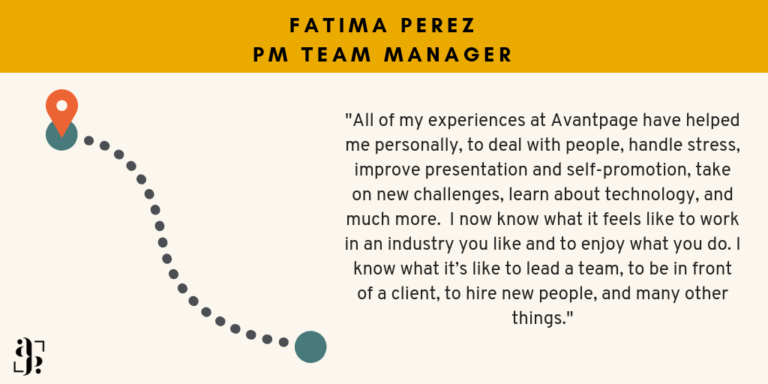
At Avantpage, we believe in providing the opportunity for all people to pursue their dreams. Not only do we live this through our mission to provide translations that help immigrants to understand the world around us, but we also live this in our daily actions as well. The journey our employees go on throughout their time at Avantpage highlights our desire to allow others to pursue their dreams and grow both professionally and personally. Fatima’s journey from Project Manager to PM Team Manager is just one example of how we live our mission. Fatima Perez started working with us as a Project Manager in our Mexico City office in January of 2015. She was inspired to apply at Avantpage because she was always drawn to languages. She struggled to find a position like this, but she found Avantpage and submitted an application to be one of our Project Managers. Even though she hadn’t studied in the industry or worked in it before, Fatima knew this was where she belonged for many reasons. “I was drawn to the company by its diverse employees with many different nationalities. During my interviews, I noticed that Avantpage really chooses the people that will be a company fit, not just based on work experience. I like that it’s not a huge company and everyone in it knows each other. Even the CEO knows who you are, and you know him, which does not happen in every company.” Fatima’s journey started with her being accepted to the open role of Project Manager. As a new Project Manager, she worked closely with our more experienced team members to set-up translation projects and provide excellent service to our clients. After a few months of this kind of training, she had some of our key clients assigned directly to her, giving her the opportunity to work independently on every stage of processing requests. For the first three years of her time at Avantpage, Fatima was focused on getting to know the industry and excelling as a Project Manager, handling some of our most demanding accounts. In her third year, she was offered the opportunity to start a transition to take on a wider leadership role within the company. This transition allowed Fatima to become our PM Team Manager, where she now oversees the entire Project Management Team at Avantpage. “Now, in addition to keeping some key accounts that have more complex projects or demands, I lead the Project Managers and Project Coordinators and support them with whatever they need. I give them advice on how to handle projects they are unfamiliar with or that require specific details. I’m also responsible for distributing accounts as evenly as possible according to each person’s skills, spotting areas of growth and development for team members, and assessing how we can be the best, most knowledgeable team possible.” While Fatima’s journey wasn’t easy, she “now feels in control and comfortable in [her] new position.” She had the opportunity to develop her leadership skills through coaching sessions, attend a conference, visit clients, travel to the Davis, CA office, and grow an entire team of Project Coordinators. Fatima’s journey has allowed her to grow both personally and professionally. “All of my experiences at Avantpage have helped me personally, to deal with people, handle stress, improve presentation and self-promotion, take on new challenges, learn about technology, and much more. I was a recent graduate when I joined Avantpage, so they have really held my hand through the process of maturity and what it means to really work. I now know what it feels like to work in an industry you like and to enjoy what you do. I know what it’s like to lead a team, to be in front of a client, to hire new people, and many other things.” Fatima’s journey is a testament to the opportunities we give to our employees, and the dedication our employees have to their work. Of her journey, she says, “In 2 words, I am honored and grateful. I think I've come very far in only a few years and I don't think other companies would give such an opportunity to someone so new and young within the organization.”
The Quick and Easy Guide to Your Next Medical Translation Project
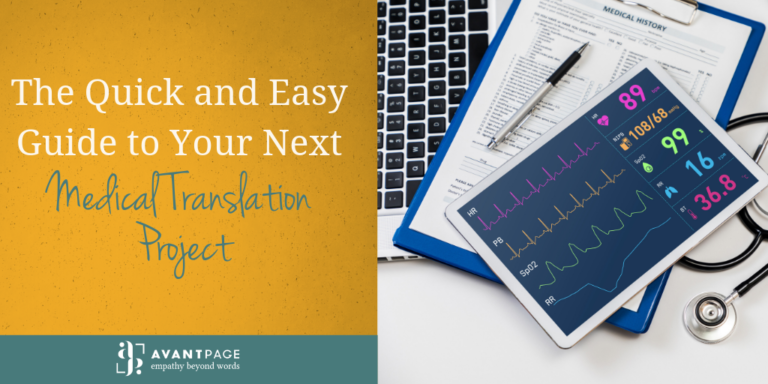
Translation projects involve a lot of moving pieces. The more informed you are on the translation process and how it works before you begin your medical translation project, the more likely it is that your projects will be successful and that you’ll be able to take advantage of savings opportunities. Once you’ve chosen a Language Service Provider (LSP) and met with your key contact, you'll provide the documents that need to be translated. Before your medical translation project begins, you may be asked to provide a glossary of standard terms or common names. If you have an English glossary, your LSP can help to translate this into your target languages as a great first step to ensuring accuracy and consistency across documents. If you have never used a glossary, now is the time to ask your LSP about the steps you need to take to create a glossary and other linguistic assets like a style guide. If you’re working with Avantpage, the next step is that we upload your original text into the translation management system, which breaks it up into segments. Our native-speaking linguistic team then translates and edits each text segment, and their work is saved in what we call a Translation Memory (TM). Your TM provides savings on your medical translation projects over time and can shorten the turnaround times on your translations. The actual process of translation is straightforward: the documents you send as part of your medical translation project will be translated by one of our certified linguists. Once the initial translation is complete, the translation will be seen by a different linguist who will edit the translation to ensure the accuracy of the translated work. Finally, your document will be sent to one of our proofreaders who will review the target text and ensure it matches the original message, tone, and is compliant with your style guide and glossary. Dependent on your organization’s goals with the medical translation project, you may require additional services. These can include: Written translation is most commonly charged by the word. The rate for your medical translation project will vary based on word count, complexity, and scope. The source language word count is generally used as a basis for the translation because the target language may differ in word count and space dependent on a variety of factors. The target language may be longer or more compact than your source language. For example, text in Spanish can take up 20% more space than the same text in English. Other elements that can increase or decrease the price of your medical translation project include language combination, formatting needs, urgency, and complexity. If you want to keep the costs of your medical translation project low, be sure to send the documents with plenty of time for translation and discuss your needs and your budget with your LSP. Like rates, the time a medical translation project takes depends on the project itself. A larger, more complex project will take longer than a simple one. Additional time is required for text that requires heavy formatting (DTP - Desktop Publishing) after translation. The time it takes to complete a medical translation project is heavily dependent on the length and complexity of your document. For projects of all sizes, you can ensure quick and efficient completion by compiling all the documents and data your LSP will need in advance. You should also be sure to send your documents in an editable format so your LSP won’t have to recreate them prior to beginning the translation. The more organized you can be, the more quickly the process will go. Each medical translation project is different, with varying timelines, costs, and needs. We can help you start your next medical translation project. Give us a call at 530-750-2040 or request a free quote today.
What Is the Difference Between a Translator and an Interpreter?
Language Service Providers (LSPs) offer a wide variety of services, with interpretation and translation being two of the most frequently requested language services. While they share a common goal, the difference between translators and interpreters matter significantly in execution, skillset, and application. In this guide, we’ll walk through the difference between interpretation and translation, how to understand which service is needed for your project at hand,and why both matter in industries like healthcare, government, and legal proceedings. Table of Contents How to Differentiate Between Interpretation and Translation What Does an Interpreter Do? What Does a Translator Do? Do you need interpretation and translation? Why The Difference Matters in Regulated Industries Frequently Asked Questions About the Difference Between Translator and Interpreter Need Help With Interpretation or Translation? When people hear the words “translator” and “interpreter,” they often assume the two roles are interchangeable — but they serve very different functions. Understanding the difference between a translator and an interpreter is especially important in fields like healthcare, law, education, and government, where communication accuracy can impact lives, rights, and outcomes. The main difference between a translator and interpreter lies in the medium and timing of the communication: Interpretation is informally defined as “the facilitation of spoken or signed language communication between users of different languages.” Interpretation uses a qualified and certified interpreter to transform verbal or signed language (the source language) into a different verbal or signed language (the target language). There are several major types of interpreting: Interpreters must think on their feet, maintain confidentiality, and adapt to cultural nuance and tone in real-time. Explore interpreter services with Avantpage or learn about the differences between on-site interpreters vs. remote services. Translation is defined as “communication of the original meaning from one language (the source) to another language (the target). Translation refers to written information.” Translation is less about ensuring the exact words are translated and more about ensuring the original tone and intent of the original document are effectively translated into the target language. Translation is only used in written circumstances. Certified translators are typically used when legal validity, regulatory compliance, or public accessibility is a concern. They often work with tools like translation memory or glossaries to ensure consistency. Discover translation services with Avantpage. Whether you need an interpreter vs. translator, or both is dependent on your organization’s language access goals. If you’re working with a language that doesn’t have a written equivalent, like sign language or certain Indigenous languages, you’ll need to work with an interpreter rather than a translator. Interpretation and translation are both highly regulated for different industries as well, which affects what language services your organization needs. If you’re in the healthcare field, for example, you’ll need both interpreters and translators at your disposal. Elections also require similar accessibility to both interpreters and translators. Use a translator when: Use an interpreter when: Pro tip: Most organizations need both. For example, a school may translate report cards and policies, but also interpret during parent-teacher conferences. In fields like healthcare, government, elections, legal services, and education, miscommunication can have serious consequences. Here's why choosing the right service matters: The core difference is medium and timing: translators work with written language and interpreters work with spoken word or signed language, often in real time. Yes, but it's rare. Each role requires different skillsets and certifications. Some professionals may be trained in both, but most specialize. It depends on the context. Interpretation is often charged by the hour or minute, while translation is charged by the word or page. Real-time, on the spot needs (like medical interpreters or courtroom services) may drive up cost for interpreters. Under laws like Title VI, ADA, and Section 1557 of the ACA, organizations receiving federal funds (like hospitals and schools) must provide interpreters for individuals with LEP. Yes. Tools like OPI and VRI are effective, fast, and secure—especially when provided by vetted professionals trained in medical, legal, or educational terminology. Learn more about the differences between OPI vs. VRI interpretation services. Being bilingual doesn’t equal being trained to facilitate an interpretation or translation. Professional interpreters and translators are skilled in terminology, ethics, cultural competence, and confidentiality. Avantpage has provided professional interpretation and translation services for nearly 30 years, helping healthcare systems, school districts, election agencies, and government organizations deliver equitable access to multilingual communities. Whether you need a certified legal translator, on-demand interpreter, or a full language access plan, we’re here to help. Call us at (530) 750-2040 or request a free quote today.