
Blogs

Everything You Need to Know About Translation Glossaries and Style Guides
Translation projects require time, attention, and planning. Each project is informed by the information you provide to your Language Service Provider (LSP), including any information you have about the purpose of the document(s), the document(s) themselves, and auxiliary documents like translation glossaries and style guides. In the translation industry, these are often referred to as “linguistic assets.” Translation glossaries and style guides allow your LSP to understand your translation preferences before they begin translating your document. Knowing these preferences can help to reduce the amount of time your translation project takes, as well as ensure consistency across your translated documents. A glossary, by definition, is a set of key terms and their definitions. A translation glossary provides these same key terms and definitions, but also includes their approved translations. Glossaries are particularly useful for industry-specific terms and consistent translation of repeated terms across your documents. A style guide lays out the standards of your organization when it comes to the style, tone, and document composition. Your style guide informs your LSP, and therefore your translators, about your organization's look, voice, and general identity. Additionally, this is a great place to address practical questions such as how to handle translating acronyms, and what words should be left in English. Creating and using translation glossaries and style guides has a variety of benefits to your translation projects and your organization as a whole. If you use glossaries and style guides, you can expect: The best way to create translation glossaries and style guides that benefit your translation projects is to work directly with your LSP. Their team can direct you as to what your glossaries and style guides should look like and, more importantly, what each should include. They’ll also share more information about glossary file formats that integrate with other platforms used by your LSP, including Translation Memory. If you want your glossaries and style guides to benefit your translation projects, you need to work with your LSP to create them in a way that is understandable and effective for everyone involved, from your internal team members to your dedicated Project Managers, and the individual translators working on your documents. Using glossaries and style guides will improve the overall quality of your translated documents, saving you time and worry. We can work with you to put together these linguistic assets for your organization. Give us a call at 530-750-2040 or request a free quote today.
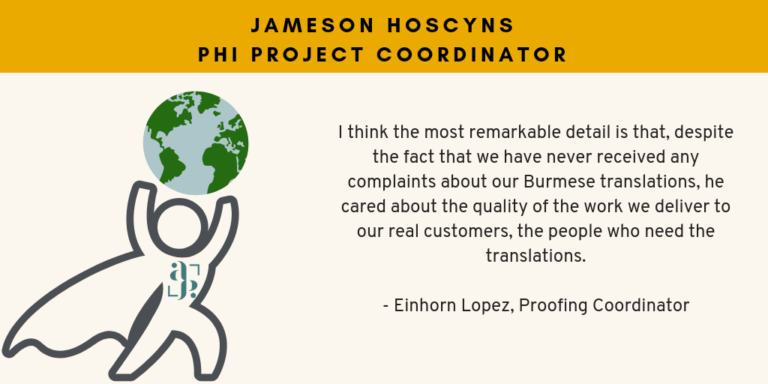
Everybody Needs a Hero: Jameson's Hero Story
Everyone is a hero to somebody. Whether a big or small act, a single act or a repetitive act, an action that you’ve taken has certainly been seen as heroic. We are all, in some way, heroes to somebody else. Our employees are no different. They go above and beyond to help our clients, team members, and communities. The actions our employees take are certainly heroic in our eyes. That’s why we asked them to submit hero stories, stories in which they witnessed a team member take a step, or many steps, beyond what is expected to assist others and truly live our brand. Jameson’s hero story is one of many that illustrates the dedication of our team members to their work, and the dedication of our team members to living our brand. Jameson Hoscyns is the PHI Project Coordinator in our Davis, CA office. Jameson’s hero story directly impacts our clients and offers a solution to a significant translation issue. In September of 2018, Jameson was preparing a Burmese letter for delivery to our client. Our Proofing Department had caught a variety of issues in this letter, and Jameson was reviewing those issues to ensure the translated letter was delivered without errors. While he was reviewing this letter, he noticed that many of the errors that were present in the letter had to do with encoding corruption. After looking at the client’s Translation Memory (TM), Jameson noticed that the Burmese in the TM had encoding issues, and he set out to fix the issue. Jameson’s hero story continued with him pulling all Burmese Translation Memories hosted by Avantpage to check the encoding of each one. He set out to make a list of recommendations to address the encoding issues and prevent any future quality issues with the Burmese language. Jameson worked diligently to find a solution to this problem and brought it to the attention of our entire Ops+Quality team in order to effectively work through the problem and find an appropriate solution. Through these discussions, Jameson was able to fix the encoding issues within the Burmese language. In doing so, he greatly reduced the possibility of future Burmese translations being inaccurate and eliminated the encoding issue. Here’s what Einhorn Lopez, our Proofing Coordinator, had to say about Jameson’s hero story: “I think the most remarkable detail is that, despite the fact that we have never received any complaints about our Burmese translations, he cared about the quality of the work we deliver to our real customers, the people who need the translations.” Jameson not only helped to ensure a higher level of quality in our Burmese translations, but he also made those translations more accessible to those that will be using and interacting with them. Jameson’s hero story is a true testament to how much our employees care about the end-users of the translations we provide, and how dedicated our employees are to their work. We’re grateful to have such dedicated members as Jameson on our team, members who truly go above and beyond to provide empathy and opportunity to all people.

Want a Thriving Business? Focus on Healthcare Localization
Healthcare should be accessible for all populations, including those that are Limited English Proficient (LEP) and need language support. While translation on its own can support accessibility, localization can provide significantly improved access to healthcare for those with language needs. Healthcare localization projects can help you customize your products, services, and internet presence to reflect differences in distinct markets. It can also help you reach new markets and grow your healthcare organization. If your organization is in an area with many different language populations, healthcare localization can help you reach these populations more effectively than translation. While translation and localization may seem similar, localization is a much more involved process. In order to ensure that your documents will effectively reach your new target audience, your healthcare localization project will include localizing graphic design, color use, currency, symbols, and many other objects in your document. The goal of doing so is to effectively create a document that feels, reads, and looks like it was originally created for the language/culture group your organization is trying to reach. Healthcare localization can provide many different benefits to your organization. If your organization offers services that are of interest to non-English-speaking customers, either in the United States or the international marketplace, localizing your software, documentation, and website will help you connect with them on a whole new level. Presenting your organization as culturally and ethnically sensitive to the needs of your customers will differentiate it from the sea of healthcare providers. Not only that, but you’re also likely to see an increase in the number of clients or patients you see due to your localized content, as more of your target population will be able to fully understand the documentation you provide them. Your organization also stands to benefit more directly from healthcare localization projects. Localization helps polish your corporate image and increase your visibility as a trusted provider of medical services. You’ll also benefit from fewer misunderstandings as more of your target population will clearly understand what you offer as a healthcare organization. Almost 26 million people in the United States speak English “less than very well,” according to the U.S. Census Bureau's 2015 American Community Survey. These LEP communities make up a vast market of potential patients or clients that you can't afford to ignore. As more and more LEP populations opt to use the internet to gather information to aid their decisions, ensuring that your website is presented in a way your local markets can understand and respond to becomes critical. Localizing your website to reach LEP populations provides vital information to these populations about their healthcare choices. If you want a dynamic way to reach new patients or clients for your healthcare organization, healthcare localization should be top-of-mind. We can help you get started with your healthcare localization projects. Give us a call at 530-750-2040, or request a free quote to get started today.

7 Election Translation Activities You Should Take Now to Prepare for 2020
When the election is right around the corner and you need to get your ballots translated, you don’t always have time for key election translation activities that will help you to improve language access in your county. While it may seem early to start thinking about translating documents for the next election, completing a selection of translation activities now can save you time, money, and stress in 2020. Create an “election translation calendar”
An election translation calendar is a planning tool and should contain all relevant deadlines for your translation project. Note when you’ll need candidate statements, ballots, voter information guides, and other materials translated on the calendar. You can then use this calendar to work backward and determine what date you’ll need to send those documents to your Language Service Provider (LSP). Update your style guide
It’s a good idea to take a look at your style guide once a year and determine if any updates need to be made; the time between election cycles is perfect for this election translation activity. Indicate how you’d like your LSP to treat acronyms, abbreviations, organization names, proper nouns, and numbers. Update your vital documents
Any standard forms you’ll need for the election should be updated as part of your election translation activities. If your registration documents, signage, or other elections materials will be changing before the next election, update them as early as possible. Standardizing these documents and making the changes you need will prevent you from having to edit last-minute. Clarify communication roles
An easy way to streamline your translation projects is to assign a point-person for contacting your LSP. You should also make a clear list of team members who will need to be copied on translation-related communications, and determine who will be responsible for making translation decisions. Research your language communities
Researching the language communities in your area is a good way to ensure that you’ll be prepared to translate into any new threshold languages. Talk to your local community leaders about the languages and dialects used by your constituents to ensure you’ll meet their needs. If you anticipate new threshold languages as part of your election translation activities, you’ll be better prepared to provide those translations to your constituents. Consider whether you’ll need DTP formatting services
If your documents would benefit from formatting services, now is the time to be gathering the files needed to pursue DTP services. Gather the original, editable files of your documents, graphics, and any additional material your LSP will need. Organize your internal translation review team
If you want to review your translations internally after they’re completed by your LSP, now is the time to put together your review team. Be sure your review team is qualified and trained on how to review the translations. If you aren’t sure how to train or certify your bilingual employees, your LSP can assist you in doing so. You’ll also want to inform your internal editing team of the kind of edits they should be making, and in what way they should be making those edits. If you tackle these election translation activities before the next election cycle, you’ll be prepared to meet the language needs of your constituents. If you want help preparing for your election translation projects, call us at 530-750-2040 or request a free quote today.

8 Questions About Translation You Need to Ask a Potential LSP
If you’re new to the translation industry, it’s likely that you have questions about translation, translation processes, and everything in-between. That’s great! You should be asking these questions before you decide on an appropriate Language Service Provider (LSP) for your translation projects. Every LSP has different methods of translator recruitment, different translation processes, etc. If you want to find the right LSP for you and your organization, ask these questions and see how well their answers match what you’re looking for. What range of language services do you offer? LSPs provide language services from translation to localization, interpreting to ADA compliance. Ask your potential LSP what services they offer so you can be sure they’ll be prepared to meet your needs. If you have a website localization project in the future, will this LSP be able to complete that service? What does your translation process look like? Does the LSP go through a three-step translation, editing, and proofreading (TEP) process? Who will be editing and proofreading your translations? One way to ensure you end up with a quality end product is to ask questions about translation processes and ensure they produce the level of quality you’re looking for. How can my organization submit edits to translated documents? Not every organization wants to review their translations after their LSP has sent them. However, if you do, and you have an internal translation review team prepared, be sure to ask questions about translation edits, best practices for submitting them, and how they’ll be integrated. What language technologies do you use? In this digital age, there is a wide variety of translation technology that can support the work of an LSP. Ask about the kinds of language technologies they employ and be wary if they say they use machine translation. Technology is helpful, but linguists should be completing your translation projects to ensure the nuances of language are appropriately attended to. Will you help my organization to create a style guide and glossary? Style guides and glossaries tell the linguists who work on your projects how you want certain terms translated, what the tone of the translation should be, what terms to avoid translating, and much more. Having a style guide and glossary helps to ensure the consistency of your translated documents. Do you use Translation Memory? Translation Memory is one of many translation technologies that are used by LSPs. This particular technology reuses past translations to increase efficiency. When your translation project is completed, the language from the original (or source) document is stored along with the language from its translated counterpart in a secure database. Having a Translation Memory can decrease the amount of time and money you spend with a translation project, so this should certainly be one of your questions about translation technology. How do you recruit the translators who will be working on our projects? Asking about the recruitment process for translators can ease your mind and help you to determine what the quality level of your translated documents will be. What are the requirements for a translator to be considered? Do the linguists need to be affiliated with professional translation associations? Do they have degrees, references, etc.? Do you test your linguists before they begin working with you? If so, how? Testing linguists through verbal or written exams supports higher quality translations. If the linguists working with your potential LSP have been tested, and they passed that test, you can feel confident they’ll be able to handle your translation requests. While there are other important questions to ask a potential new translation partner, this list will get you on the right path to finding an LSP that works effectively with your organization. If you’re looking for a new LSP, give us a call at 530-750-2040 or request a free quote today. We’d be happy to answer these questions for you!

Developing Your Language Access Plan: Planning for Translation Made Easy
Planning for translation, whether you’re new to translation or not, takes time, energy, and resources. While planning for translation may seem like an overwhelming task, there are processes that make it easier. Creating a Language Access Plan and answering a few questions for you and your team before your next translation project can help to ensure success. Planning for translation includes setting up a Language Access Plan for your healthcare organization. A Language Access Plan, simply, is how you plan to approach the needs of LEP patients regarding language services. While it is legally required by federal regulations, it also presents an opportunity to ensure that you’re providing the best possible care to LEP populations. There are four factors that you need to analyze as you move towards creating, or amending, your Language Access Plan: Throughout the planning of your Language Access Plan, return to this question: “Am I providing meaningful language access to those who need it?” Your Language Access Plan should include at least three items which will help you in planning for translation. These items include: When creating your Language Access Plan, it’s recommended that you begin to identify how you’ll handle document translations as well. While this isn’t a legally require part of your Language Access Plan, it is a legally required service you must provide as a healthcare organization. Ask yourself the following questions: Most importantly, when creating your Language Access Plan, you need to be considering the languages of your population. The top 15 languages in your area are the languages you need to be translating your documents into. Any language that has a population of speakers equal to or greater than 5% you’ll need to provide interpretation services for. Outside of creating your Language Access Plan, planning for translation includes a variety of other tasks. This involves asking yourself a series of questions: If you dedicate time and resources to planning for translation, you’ll be much more likely to see success from your translation projects. If you want guidance on creating your Language Access Plan or planning for translation, call us at 530-750-2040 or request a free quote today.
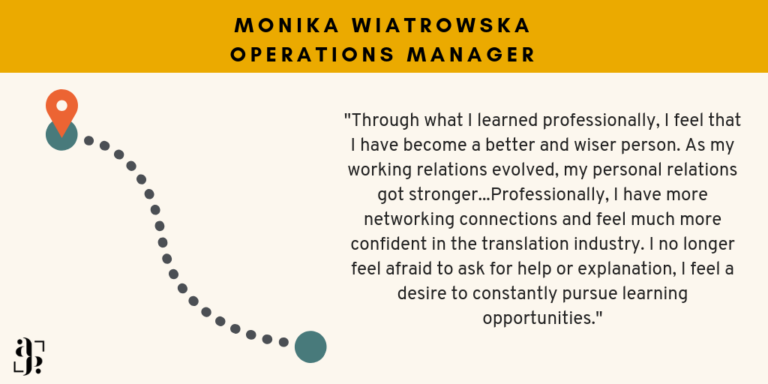
Monika's Journey at Avantpage
At Avantpage, we believe in providing the opportunity for all people to pursue their dreams. Not only do we live this through our mission to provide translations that help immigrants to understand the world around us, we live this in our daily actions as well. The journey our employees go on throughout their time at Avantpage highlights our desire to allow others to pursue their dreams and grow both professionally and personally. Monika’s journey from Project Manager to Operation Manager is just one example of how we live our mission. Monika Wiatrowska started working with us as Project Manager at the Mexico office in December of 2013. She was inspired to apply at Avantpage because of the position’s relation to her degree in Spanish Studies. Though she had never worked in the translation industry before, she was excited to learn about a new industry that could bring her new experiences and satisfaction. Monika’s journey started with her being accepted to the open role of Project Manager. As a Project Manager, she processed documents to be translated for our clients. After a few months of training, she had clients assigned directly to her which gave her the opportunity to work on every stage of processing the requests. From receiving source files to invoicing the closed project, Monika saw to it that every step of the process was taken care of. In the process of learning about the translation industry, it became clear that Monika was a very fast learner. Her manager, Vera, quickly took notice and allowed her to learn more about the automations and advanced features offered by our translation tools. After two years in the Mexico office, and being incredibly happy in her position, Monika’s journey took her back to Poland for personal reasons. As she puts it, “even though one chapter in my life ended, the journey had just begun.” Avantpage opened a new satellite office in Poland, and Monika was offered the position of Operations Coordinator, which she enthusiastically took. While Monika’s journey wasn’t easy, she “received all the support in order to handle healthy and professional relations within the company.” She had the opportunity to develop her leadership skills through coaching sessions, attend conferences, visit US clients, and travel back to the Mexico office. Monika’s journey has allowed her to grow both personally and professionally. “Through what I learned professionally, I feel that I have become a better and wiser person. As my working relations evolved, my personal relations got stronger. I solved personal problems in a more mature way because of how I had learned to solve issues at work. Professionally, I have more networking connections, and feel much more confident in the translation industry. I no longer feel afraid to ask for help or explanation, I feel a desire to constantly pursue learning opportunities.” Monika’s journey is a hallmark to the opportunities we give to our employees, and the dedication our employees have to their work. Of her journey, she says, “I feel very grateful for the opportunities that I have been given.”
Everything You Need to Know About Our Translator Testing Process
When you hire a Language Service Provider (LSP) like Avantpage, you’re trusting that qualified, professional translators will be handling your language needs. At Avantpage, our linguists are put through a rigorous testing process to ensure they will be able to meet the needs of our clients. Our translator testing process involves multiple steps, from verifying credentials all the way to a complete onboarding package. When translators apply to work with Avantpage, we collect a wide variety of information to ensure their credentials meet our standards. We begin by reviewing their resume, and any supporting documentation they’ve sent in. We require that all of our translator applicants send verification of their certifications, including any language associations with which they’re certified, any schooling they’ve completed, and any additional certifications that prove their knowledge and skill in the translation field. When we verify credentials, we also look to ensure that the translator is qualified to use Computer Assisted Translation (CAT) Tools and speak to any references they have listed. Our translator testing process includes a competency test. Our Quality Management Team has developed three different competency tests for the fields of healthcare, elections, and social services, as well as a variety of Spanish-to-English translation tests, as that is our most frequently requested language pair. These tests are aligned with ISO 17100 standards to support our quality values, and they focus on the following competencies: The completed test is sent to one or more of our current editors and proofreaders, who score the test in each one of the above competencies. The most highly competent translators are selected by our Provider Management Team, and receive an invitation to partner with Avantpage as a contracted translator. Once a translator has accepted the invitation, a full onboarding system including internal training, monitoring by our Project Management Team, and constant feedback on linguistic and non-linguistic evaluation. This translator testing process allows us, and our clients, to have full confidence in our translators as they work diligently to translate documents on-time and in-budget. If you’d like to start a new translation project with trusted and verified translators, give us a call at 530-750-2040 or request a free quote today.
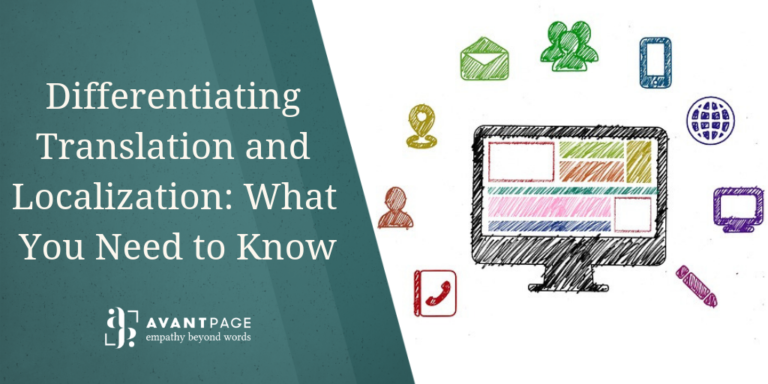
Differentiating Translation and Localization: What You Need to Know
Translation and localization are often paired together when you’re searching the internet for information on how to start your next translation project. While the two processes have similarities, translation and localization are two different linguistic concepts. Understanding that difference can not only benefit your next translation project, but also help you to globalize your business more effectively. To accurately determine the differences between translation and localization, we need to start by defining what each process is, and what is involved in each process. Translation is defined as the communication of meaning from one language (the source) to another language (the target). Translation refers specifically to written information. Localization is defined as the process of adapting a product or content to a specific locale or market. Translation is one of the elements of the localization process, but the process consists of several other elements as well. The major similarity between translation and localization is that they both involve the translation of a document from a source language to a target language. The two processes also involve the Translation, Editing, Proofreading (TEP) process to ensure the translation is accurate and of high-quality. This three-step process involves the original translation of your document, the editing of that translation to catch any errors, and the proofreading of the edited document to ensure that the original content is reflected in the translation and that the translation is error-free. While localization involves the process of translation, localization also involves many other processes. The ultimate goal of localization is to adapt your content so that when it is viewed by your target audience (the audience that will view it after localization), it feels as though the content was originally created in the target language and for the target culture. Beyond translation, localization also involves: Localizing your content can help you to reach new business markets and ensure that your content will be well-received in the target culture. If you’d like to learn more about localization, or you’d like to start a localization project, call us at (530) 750-2040 or request a free quote today.

12 Best Practices for Healthcare Translation That Will Save You Time and Money
If you’re new to needing translation, the entire process may seem overwhelming. There are many different documents that need to be translated, regulations to be aware of, and a wide variety of moving parts. These best practices for healthcare translation can help you maintain control of your translation projects and get you started on the right path. Before you find a qualified and professional Language Services Provider (LSP) for your healthcare translation needs, best practices for healthcare translation include asking some critical questions: You may find that there is a particular linguistic group within your area that is not yet considered a “threshold” language. Do research to see if that population is growing and if it makes sense for your organization to provide translations in that language. Some healthcare organizations may have a cultural and linguistics department that oversees and coordinates healthcare translations, but some may not. No matter your organization's internal structure, best practices for healthcare translation state that you will need to allocate an appropriate budget, and appoint a person or team of people to handle communications with your LSP. When it comes to selecting an LSP, get well-acquainted with their translation process and quality assurance procedures, as well as the costs. Make a list of questions you need the LSP to answer, such as questions about translator qualifications and testing, data safety, and appropriate turnaround times. Any serious LSP will be excited to answer your questions, partner with you, and walk you through the process of translating your documents. This is the best way to learn about translation, create a lasting partnership, and follow best practices for healthcare translation. Using bilingual employees to perform translations puts you at risk for inaccurate translations and potentially even legal action. Beyond that, having bilingual employees complete your translations takes them away from other vital projects. Hiring a professional medical translation company is one of the best practices for healthcare translation, and can help ensure accuracy and consistency. Work with your LSP to determine your process, what steps will take place each time a document is translated, and how your specific needs will be met. Establishing a clear and detailed timeline from the beginning helps both sides move through the process smoothly. You should also be sure to note any text in a document that cannot or should not be translated for legal reasons. This will ensure that, when it comes time for translation, this text remains in the original language. Finally, in your planning, ensure that you know the written language that the document needs to be translated into. There are a variety of languages that are spoken and not written, or written and not spoken, so checking to ensure that you’re requesting translation to a written language can save you time. Best practices for healthcare translation state that the best way to coordinate your translations is by involving executive-level personnel. If you involve them from the beginning of your medical translation project, you can save time and frustration in the long run. Get this person, or these people, involved in your process from the very beginning and keep them informed throughout the project. This will ensure consistency throughout all documents and make for a smoother project. Compiled manually, style guides and glossaries will increase the overall quality and consistency of your documents. A glossary contains important terms with their preferred translations, and the style guide tells translators about linguistic and stylistic preferences, such as the audience and tone of the document. The glossary includes recurrent words/phrases that need to be translated the same way to make sense in the target language. Your LSP can help you put together these documents so you’re following best practices for healthcare translation. Vital documents contain information that is critical for accessing the provider or agency services and/or benefits, some examples include letters or notices that require a response from the customer or documents that inform customers of free language assistance. Vital documents can also include applications, consent forms and letters, or other template-based correspondence. A non-standard document might contain information specific to one person, to an event, or any other evolving subject matter. Standardizing your vital documents can save you time and money as you won’t have to repeat the translation projects. Best practices for healthcare translation also include keeping your audience in mind while designing and writing your documents. If your audience reads at an elementary school level, write your documents at the same reading level and keep information as simple and clear as possible. This will also help you when it comes time to have documents translated. Documents that require certain wording for legal purposes can still be written in words everyone can understand—it may just take a little extra effort. It is important to remember that if a translation is required to be at a certain grade level, the English text should also be provided at that same level. After you’ve completed your first healthcare translation project, it will become clear how translation is more than just compliance. It’s a tool to reach new markets, keep your patients or members safe, and improve your organization’s social standing. Quality translations can be part of an investment strategy that will eventually have a major payoff. By following this process, you can ensure a successful medical translation project. If you’d like to get started with your first healthcare translation project, call us at 530-750-2040 or request a free quote today.
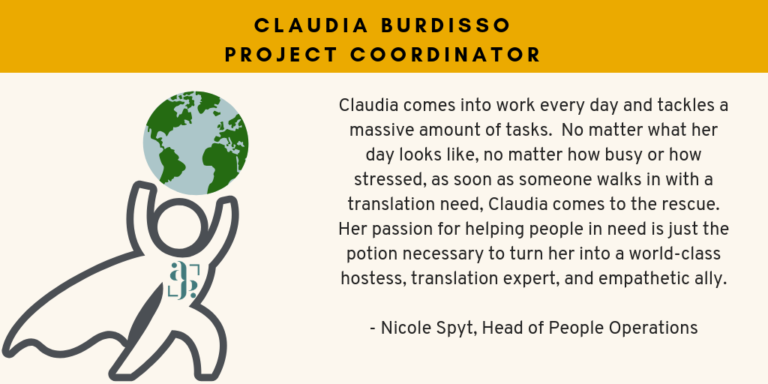
Everybody Needs a Hero: Claudia's Hero Story
Everyone is a hero to somebody. Whether a big or small act, a single act or a repetitive act, an action that you’ve taken has certainly been seen as a heroic. We are all, in some way, heroes to someone/somebody else. Our employees are no different. They go above and beyond to help our clients, team members, and communities. The actions our employees take are certainly heroic in our eyes. That’s why we asked them to submit hero stories, stories in which they witnessed a team member take a step, or many steps, beyond what is expected to assist others and truly live our brand. Claudia Burdisso is a project coordinator in our Davis, CA office. One of her responsibilities is to ensure that all individual translation requests are appropriately addressed and responded to in a timely manner. Normally we work with other businesses to translate their documents, but when an individual translation request comes in, Claudia goes to great lengths to ensure that it is addressed. Here’s what our Head of People Operations, Nicole Spyt, said about Claudia and her dedication to each individual who needs a document translated. “Claudia comes into work every day and tackles a massive amount of tasks. However, no matter what her day looks like, no matter how busy or how stressed, as soon as someone walks in with a translation need, Claudia comes to the rescue. Her passion for helping people in need is just the potion necessary to turn her into a world-class hostess, translation expert, and empathetic ally. Whenever I get to witness this exceptional caring and dedication it reminds me why we do what we do.” The clients Claudia cares for “always feel very well taken care of. In fact, they usually wind up striking up interesting conversations with Claudia, as if she is an old friend.” Nicole continued to say “it is amazing to watch Claudia go from being so focused on a massive amount of work to completely dedicating all of her attention to the person in need.” Claudia’s hero story is a true example of our brand. Her deep dedication to the end-user, the individuals who rely on our translations for the information they need, is what we resolutely stand for. Her heroic actions on a daily basis reflect the best of our company culture, our dedication, and our work. We’re grateful to have such dedicated members as Claudia on our team, members who truly exhibit the concept of Empathy Beyond Words.
Creating an Internal Translation Review Team: What You Need to Know
There are many different options for internally reviewing the translated documents provided by your Language Service Provider (LSP). While we put our translations through a rigorous series of translation, editing, proofreading, and quality checking, many different organizations wish to put together an internal translation review team to ensure quality, accuracy, and cultural awareness. If you choose to internally review your translated documents, a qualified internal translation review team is essential and highly recommended. The difference between a qualified team and an unqualified team can mean hours saved on your translation project. Like any other job, there are particular qualifications that are important for your internal translation review team to have. In the best-case scenario, all internal reviewers would be qualified translators. The benefits of having qualified translators on your internal review team are numerous. Not only will they be able to effectively notice grammar and spelling mistakes, but they’re also trained to keep the translations as close to the original text as possible. If your organization doesn’t have the ability to create an internal review team with qualified translators, bilingual employees can be trained to provide the review that you need. If you choose to use bilingual employees for your internal review team, it’s essential to train the team on what they should be looking for in your translated documents. Your internal translation review team should be looking for consistency among commonly translated terms, and adherence to your style guide and glossary. If you want your team to review for spelling and grammar errors, ensure that they understand the intended tone of the document, the voice of your company, and the content of the original document. Bilingual employees are more likely to add preferential edits than qualified translators. This means they edit based on their word or phrase preferences, as opposed to mistakes or inaccurate translations. While preferential editing is bound to happen, it’s best to guide your team away from it. This can cause back-and-forth between your team and your LSP, preventing the completion of your translations. In addition, LSPs may apply charges for making edits that are considered to be purely preferential. Make sure to provide your internal translation review team with the same style guide and glossary you provided to your LSP, and train them on the importance of using it. They will also need both the original document and the translated text. Providing them with this documentation will help them to look for consistency within your documents, and help them to ensure that your documents contain no incorrectly translated terms. We can help guide you as to the best ways to put together your internal translation review team and work with them to make sure your documents are of the highest quality and accuracy possible. Call us at 530-750-2040 or request a free quote for more information.